
In a world filled with endless distractions, mastering the art of focus has become a student’s most critical skill. Simply trying harder isn’t enough; the key is to work smarter by adopting proven, evidence-based techniques. The difference between feeling overwhelmed and being in control often comes down to the quality of your study system. This guide moves beyond generic advice like ‘turn off your phone’ and dives into 10 powerful focus strategies for students, each backed by cognitive science and designed for practical application.
You’ll learn not just what to do, but exactly how to implement these methods, overcome common pitfalls, and measure your progress. Managing this academic balancing act requires a solid toolkit. To support a smarter approach to studying, exploring the best student productivity apps can be incredibly beneficial for structuring your sessions and tracking your efforts.
Whether you’re battling procrastination, struggling with complex topics, or simply want to study more efficiently, this list provides the actionable framework you need. We’ll cover everything from time management systems like the Pomodoro Technique to memory-enhancing methods like Spaced Repetition and the Loci Method. It’s time to build a system that helps you succeed academically and reclaim your attention.
1. Pomodoro Technique
The Pomodoro Technique is one of the most effective focus strategies for students because it turns daunting study sessions into manageable sprints. Developed by Francesco Cirillo in the late 1980s, this method uses a timer to break down work into focused 25-minute intervals, separated by short 5-minute breaks. After four of these cycles (called “Pomodoros”), you take a longer break of 15-30 minutes.
This cyclical approach creates a sense of urgency that helps you start tasks you might otherwise put off. It also prevents mental burnout by building rest directly into your workflow, making it easier to maintain high-quality concentration over several hours.

How to Implement It
To get started, simply choose a task, set a timer for 25 minutes, and work without interruption. When the timer rings, mark your progress and take a 5-minute break. It’s crucial that you step away from your work during this break.
Actionable Tips
- Use a Physical Timer: The act of setting a physical timer can create a stronger psychological commitment than using a silent app.
- Customize Your Intervals: If 25 minutes feels too short for subjects like complex math problems, try extending your focus blocks to 45 or 50 minutes, followed by a 10-minute break.
- Plan Your Breaks: Use short breaks for physical movement like stretching or walking. Save longer breaks for grabbing a snack or checking your phone.
- Track Your Pomodoros: At the end of a study session, count how many Pomodoros you completed. This provides a clear, satisfying measure of your focused effort.
2. Active Recall
Active Recall is a powerful study method that transforms learning from a passive act of re-reading into an active process of memory retrieval. Instead of simply reviewing notes or textbook chapters, you challenge your brain to pull information from memory without assistance. This deliberate effort to retrieve knowledge strengthens neural pathways, making long-term retention far more effective than passive review.
This approach is one of the most effective focus strategies for students because it forces deep engagement with the material. By testing yourself, you quickly identify what you know and, more importantly, what you don’t, allowing you to focus your efforts where they are needed most. For students looking to deeply engage with their reading material and boost retention, applying active learning principles is essential. Discover additional smart tips for studying a textbook effectively.
How to Implement It
To use Active Recall, close your book or notes and try to explain a concept aloud, write down a summary from memory, or use flashcards to test yourself on key terms. The key is to force your brain to work to recall the information rather than passively consuming it.
Actionable Tips
- Create Question-Based Flashcards: Write questions on one side and detailed answers on the other. This encourages retrieval rather than simple recognition.
- Teach the Concept: Try explaining a topic to a friend or even an empty room. This forces you to organize your thoughts and solidify your understanding.
- Practice with Problems First: Before looking at the solution, attempt to solve problems from your textbook or past exams on your own.
- Embrace the Struggle: The feeling of difficulty is a sign that the learning process is working. Don’t be discouraged if you can’t recall something immediately.
3. Spaced Repetition
Spaced Repetition is a powerful learning technique that transforms how you memorize information, making it one of the most efficient focus strategies for students. Instead of cramming, this method involves reviewing material at increasing intervals over time. It’s based on the psychological “spacing effect,” which shows that we learn more effectively when study sessions are spaced out.
This approach works by interrupting the natural process of forgetting. By reviewing a concept right as your brain is about to forget it, you strengthen the neural pathways associated with that memory. This makes it ideal for subjects heavy on memorization, such as vocabulary for a new language, key historical dates, or complex anatomical terms in medical school.
How to Implement It
The core of Spaced Repetition is a schedule. You review new information frequently at first, then gradually decrease the frequency as you master it. For example, you might review a new concept after one day, then three days, then a week, and so on.
Actionable Tips
- Automate with Apps: Manually tracking review intervals is tedious. Use digital flashcard apps like Anki or RemNote that automatically schedule your reviews. For more options, you can find some of the best productivity apps for students on chronoid.app.
- Start from Day One: Don’t wait until exam season. Begin creating flashcards and using spaced repetition from the very first lecture of a course to build long-term retention.
- Create Quality Questions: Your recall will only be as good as your prompts. Formulate clear, concise questions that target a single piece of information.
- Never Skip a Review: The system’s effectiveness depends on consistency. Sticking to the schedule ensures you review information at the optimal moment before it’s forgotten.
4. Deep Work Blocks
Deep Work Blocks involve scheduling long, uninterrupted periods (typically 2-4 hours) for your most demanding academic tasks. Popularized by author Cal Newport, this method is one of the most powerful focus strategies for students because it facilitates a state of “flow,” where you can process complex information without the mental cost of context-switching.
This strategy is ideal for cognitively heavy activities like writing a dissertation chapter, debugging code, or systematically working through challenging problem sets. By dedicating a significant chunk of time to a single objective, you can achieve breakthroughs that are impossible during fragmented, 15-minute study intervals.

How to Implement It
To start, identify a high-priority, complex task. Schedule a 2 to 4-hour block in your calendar as a non-negotiable appointment. Before you begin, gather all necessary materials and eliminate every potential distraction to protect your focus.
Actionable Tips
- Go Offline: Turn off your phone and disable Wi-Fi unless it’s essential for the task. Use a dedicated focus app for Mac to block distracting websites and apps.
- Schedule During Peak Hours: Identify when your energy and concentration are highest (e.g., early morning) and reserve those times for deep work.
- Communicate Your Unavailability: Let friends, family, or roommates know that you will be unavailable during your scheduled block to prevent interruptions.
- Integrate Micro-Breaks: Use the Pomodoro Technique within your deep work block. A 50-minute focus sprint followed by a 10-minute break can help maintain stamina.
5. The Feynman Technique
The Feynman Technique is a powerful mental model that shifts your goal from memorization to genuine understanding. Developed by Nobel Prize-winning physicist Richard Feynman, this method forces you to engage deeply with material by explaining it in the simplest terms possible, as if you were teaching it to someone else.
This process is one of the most effective focus strategies for students because it instantly reveals gaps in your knowledge. When you can’t explain a concept simply, it means you don’t fully understand it yet. This forces you to return to your source material, concentrate on the weak points, and build a much stronger conceptual foundation.
How to Implement It
Start by choosing a concept you want to learn, like photosynthesis. Write the name of the concept at the top of a blank page. Then, write out an explanation of it in plain, simple language. Read your explanation aloud and pinpoint any areas that are confusing, overly complex, or where you have to refer back to your notes.
Actionable Tips
- Use Analogies: Connect complex ideas to simple, everyday experiences. For example, explain atomic bonding by comparing it to magnets.
- Avoid Jargon: Force yourself to explain the topic without relying on technical terms. If you must use a specific term, make sure you can define it simply.
- Test It on a Friend: Try explaining your topic to someone with no background in the subject. Their questions will quickly show you where your explanation is weak.
- Write by Hand: The physical act of writing can help you process and retain information more effectively than typing.
- Review and Refine: Go back to your source material to fill in the knowledge gaps you identified, then simplify your explanation again. Repeat until it’s clear and concise.
6. Interleaving
Interleaving is a powerful study method where you mix multiple related topics or problem types during a single session instead of focusing on one at a time (known as “blocking”). This approach is one of the most effective focus strategies for students dealing with complex subjects like math or science because it trains your brain to identify the correct solution method, not just execute a familiar one.
While it can feel more difficult and less productive in the moment, interleaving forces you to constantly retrieve and apply different concepts. This “desirable difficulty” strengthens long-term memory and improves your ability to transfer knowledge to new situations, which is crucial for exams where problems are often mixed up.
How to Implement It
Instead of completing all your algebra problems before moving on to geometry, do a few of each, alternating between them. For a language class, don’t just drill one verb tense; mix it with other tenses you’ve already learned to practice recognizing when to use each one.
Actionable Tips
- Mix 2-3 Related Topics: Start by interleaving a small number of related concepts. For example, in physics, alternate between problems on momentum, energy, and force.
- Randomize Problem Sets: When using practice questions, don’t just go in order. Shuffle them so you can’t predict what type of problem is coming next.
- Focus on Categorization: Before solving a problem, take a moment to identify its type and the specific strategy required. This builds the critical skill of discrimination.
- Start After Initial Learning: Use interleaving for review and practice, not for learning a concept for the very first time. You need a foundational understanding before you can effectively mix topics.
7. Mind Mapping
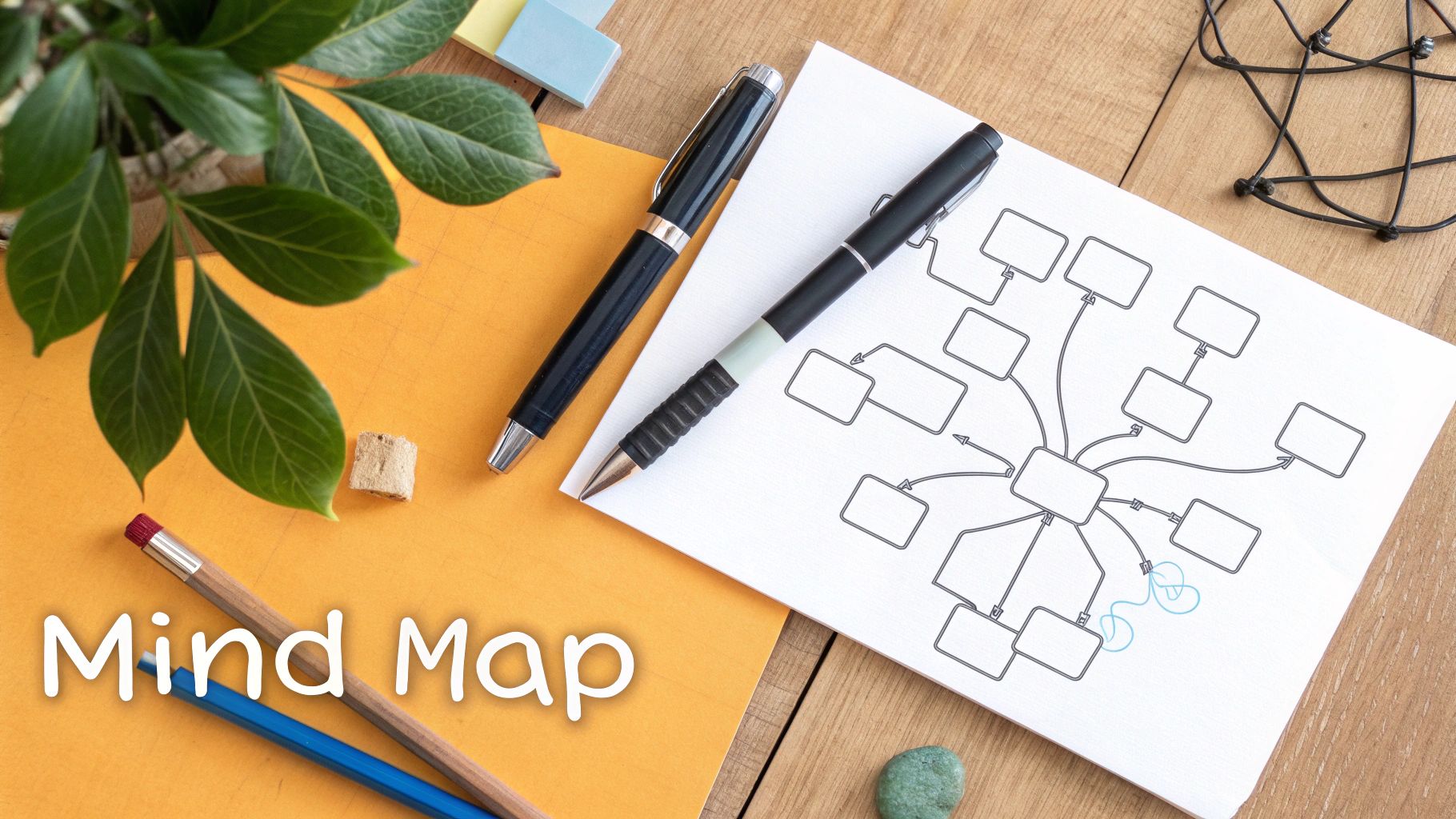
Mind mapping is a powerful visual technique that makes it one of the most creative focus strategies for students. Instead of linear notes, this method organizes information around a central concept, with ideas branching out like a tree. This non-linear format mirrors how our brains naturally make connections, helping to clarify complex topics, improve memory recall, and make studying more engaging.
It transforms passive information consumption into an active process of organization. By visually linking concepts, you can see the bigger picture and understand how details relate to main ideas, which is especially useful for subjects like biology, literature, and history.
How to Implement It
Start with a central topic in the middle of a blank page. From there, draw branches for main ideas, then add smaller sub-branches for supporting details, keywords, and examples. Use single words or short phrases to keep the map clean and easy to read.
Actionable Tips
- Use Color and Images: Assign different colors to major branches to visually separate themes. Add simple icons or drawings to make key concepts more memorable.
- Keep Branches Concise: Use one keyword per branch where possible. This forces you to distill information to its core, which aids in comprehension and retention.
- Embrace Digital Tools: Apps like MindMeister or XMind allow you to easily edit, expand, and reorganize your maps, making them perfect for ongoing projects or complex subjects.
- Structure with Hierarchy: Your central idea is level one, main branches are level two, and sub-branches are level three. This clear hierarchy helps organize thoughts logically.
8. The Loci Method (Memory Palace)
The Loci Method, or Memory Palace, is an ancient mnemonic device that boosts retention by linking information to familiar physical locations. This is one of the most powerful focus strategies for students as it transforms abstract data into a memorable visual journey. By mentally “placing” facts along a well-known route, like your walk to class or the layout of your home, you leverage your brain’s powerful spatial memory to recall complex sequences.
This technique forces deep focus because it requires you to actively create vivid, multisensory associations rather than passively rereading notes. It’s particularly effective for subjects that require memorizing ordered information, such as historical timelines, steps in a scientific process, or even key points for a presentation.
How to Implement It
Start by choosing a physical location you know intimately, like your house. Mentally walk through a specific path, identifying distinct locations or “loci” along the way (e.g., your front door, the kitchen table, the sofa). Then, associate each piece of information you need to remember with one of these loci using a bizarre or exaggerated mental image.
Actionable Tips
- Choose a Familiar Place: The more detailed your knowledge of the location, the stronger the memory hooks will be. Your childhood home or daily commute are excellent starting points.
- Create Bizarre Imagery: The stranger and more humorous the mental image, the more it will stick. To remember a historical date, imagine it painted dramatically on your bedroom wall.
- Engage Multiple Senses: Don’t just visualize; imagine the sounds, smells, and textures associated with your image to make it more real and memorable.
- Walk Through It Repeatedly: Practice mentally walking through your Memory Palace to strengthen the connections. The first few times are crucial for cementing the information.
9. Metacognition and Self-Explanation
Metacognition is the practice of thinking about your own thinking. As one of the most powerful focus strategies for students, it involves actively monitoring your understanding and adjusting your learning approach in real-time. Instead of passively reading or listening, you constantly ask yourself: “Do I truly understand this?” or “How does this connect to what I already know?”
This self-awareness transforms studying from a passive activity into an active, strategic process. By explaining concepts to yourself, you quickly uncover knowledge gaps and solidify your comprehension. This method builds a deeper, more durable understanding of the material, making it easier to recall information during exams and apply it to new problems.
How to Implement It
As you study, pause periodically to explain the concept you just learned in your own words, as if you were teaching it to someone else. After solving a problem, retrace your steps and articulate the reasoning behind each one. This act of self-explanation is the core of metacognitive practice.
Actionable Tips
- Ask “Why” Constantly: While reading a chapter or solving an equation, frequently ask yourself why a certain formula works or why a historical event occurred.
- Keep a Learning Journal: After each study session, write a brief reflection on what you understood easily, what was confusing, and what strategy you might try next time.
- Record Yourself: Use your phone to record a short audio clip of you explaining a difficult topic. Listening back will reveal areas where your understanding is weak.
- Analyze Your Mistakes: When reviewing a test or assignment, don’t just look at the right answer. Explain precisely why your original answer was incorrect and what thought process led you there.
10. Environment Optimization and Environmental Psychology
One of the most powerful focus strategies for students involves consciously designing your study space. Environment Optimization leverages principles from environmental psychology, which suggests that our physical and digital surroundings profoundly impact our ability to concentrate. By strategically arranging your environment, you can reduce the mental effort needed to fight distractions and make focused work the easiest option.
This approach is about creating external controls to support your internal willpower. Instead of relying solely on self-discipline to ignore a buzzing phone or a cluttered desk, you remove those triggers entirely. This creates a powerful psychological association where your designated study space signals to your brain that it’s time to concentrate, making it easier to get into a state of deep work.
How to Implement It
Start by designating a specific spot solely for studying, like a particular desk or a corner in a library. Before each session, clear the area of everything except the essential materials for the task at hand. Critically, remove your biggest distractions, especially your smartphone, from your immediate vicinity.
Actionable Tips
- Create a “Focus Zone”: Dedicate a specific desk or even a chair just for studying. Avoid doing leisure activities like watching videos or scrolling social media in this space.
- Optimize Your Digital Space: Close all irrelevant browser tabs and applications. Use a website and application blocker to prevent access to distracting sites during your study blocks. Learn more about using a web blocker to enhance focus.
- Control Your Sensory Input: Use noise-canceling headphones to block out disruptive sounds. Experiment with ambient noise or instrumental music to see if it aids your concentration.
- Put Your Phone Away: The most effective trick is often the simplest. Place your phone in another room or turn it completely off to eliminate the constant temptation of notifications.
10 Student Focus Strategies — Comparison
| Method | Implementation Complexity 🔄 | Resource & Tools ⚡ | Expected Outcomes 📊 | Ideal Use Cases 💡 | Key Advantages ⭐ |
|---|---|---|---|---|---|
| Pomodoro Technique | Low — simple timer-based cycles | Minimal — timer/app, quiet spot | ⭐⭐⭐ — increased focus, better time-on-task, reduced fatigue | Short tasks, beat procrastination, habit building | Easy to start; prevents burnout; time tracking |
| Active Recall | Medium — needs question generation & discipline | Flashcards, practice tests, apps (Anki) | ⭐⭐⭐⭐⭐ — strong long-term retention; quick gap detection | Exam prep, vocabulary, concept mastery | Most effective retention method; research-backed |
| Spaced Repetition | Medium–High — initial setup and scheduling | SRS apps (Anki), consistent review plan | ⭐⭐⭐⭐⭐ — maximal long-term retention with less total study time | Language learning, medical studies, cumulative review | Efficient retention; prevents cramming; data-driven timing |
| Deep Work Blocks | High — requires scheduling and distraction control | Dedicated time blocks, blockers, quiet workspace | ⭐⭐⭐⭐ — deep understanding and high-quality output | Complex problem solving, writing, programming | Enables flow; reduces context-switching; high-quality work |
| Feynman Technique | Medium — iterative explaining and refinement | Paper/notes, peer or recording device | ⭐⭐⭐⭐ — clearer conceptual understanding; exposes gaps | Conceptual subjects, teaching, essay prep | Forces simplification; reveals misconceptions; builds mastery |
| Interleaving | Medium — needs planning to mix topics | Mixed problem sets, varied practice materials | ⭐⭐⭐⭐ — better transfer, discrimination, application skills | Math problem types, mixed-skill practice, exam prep | Improves adaptability; reduces overconfidence from blocking |
| Mind Mapping | Low–Medium — visual organization skill helpful | Paper/pens or digital tools (MindMeister, XMind) | ⭐⭐⭐ — improved organization, visual memory, creativity | Brainstorming, planning, organizing complex topics | Reveals relationships; engages visual thinking; flexible |
| Loci Method (Memory Palace) | High — steep learning curve; visualization skill | Imagination practice; time to encode associations | ⭐⭐⭐⭐ — exceptional recall for ordered/discrete items | Memorizing speeches, lists, vocabulary, competitions | Very high-capacity, durable recall; engaging mnemonic power |
| Metacognition & Self-Explanation | Medium–High — practice to develop reflective skill | Journal, prompts, recordings, time for reflection | ⭐⭐⭐⭐ — better self-regulation, transfer, strategy selection | Self-directed learning, test review, problem-solving | Identifies misconceptions early; improves study strategy |
| Environment Optimization | Medium — initial setup and habit changes | Ergonomic setup, blockers, headphones, lighting | ⭐⭐⭐⭐ — substantial focus gains; less cognitive load | Anyone prone to distraction; deep work; shared spaces | Reduces distractions; supports sustained focus; low cost |
markdown
Turn Strategy Into Habit: Your Path to Consistent Focus
Key Takeaways
Focus strategies for students provide a roadmap to overcome distraction, optimize memory, and sustain deep work. Each technique in this roundup is evidence based and includes clear steps, real examples, and common pitfalls. By combining rhythm, recall, and environment tweaks you form a personalized system that adapts as you learn and grow.
- Productivity Rhythms: Apply the Pomodoro Technique and Deep Work Blocks to alternate focused sessions with recovery breaks.
- Memory Boosters: Leverage Spaced Repetition and the Loci Method to cement knowledge over time.
- Cognitive Deepening: Use Active Recall, the Feynman Technique, and Metacognition for insight and problem solving.
- Environment Tuning: Integrate Interleaving, Mind Mapping, and workspace optimization for reduced distractions and creative flow.
Most important takeaways:
- Consistency matters more than intensity when building study habits.
- Data-driven tracking reveals your peak focus windows.
- Small adjustments to timing and environment produce outsized gains.
- Regular review stops knowledge decay and increases retention.
- Reflecting on errors refines your approach and boosts confidence.
Next Steps
It is time to move beyond knowing into doing. Choose one or two focus strategies that match your learning style and current challenges. To track progress objectively, consider using a tool like Chronoid for automatic session logs and AI-driven insights.
- Schedule a 25-minute Pomodoro or 50-minute Deep Work Block today.
- Practice spaced repetition with flashcards on key topics before each session.
- Set up your study space with minimal noise, strategic lighting, and clear visual cues.
Real progress comes from small changes you can repeat daily
After each week, review your Chronoid data or manual logs. Adjust your time blocks, memory intervals, or environment elements based on actual results. This feedback loop cements habits and prevents decision fatigue.
Why This Matters
Mastering focus strategies for students builds more than exam readiness. It develops a lifelong capacity for concentration, creativity, and efficient learning. Improved focus reduces stress, fosters mental clarity, and supports sustained success across academics and career pursuits.
By embedding these methods into daily routines you unlock deeper engagement with every subject. The skills you cultivate now will serve you through research, professional projects, and personal goals alike. Start small, track your data, and watch consistent focus become second nature.
Ready to take control of your study time? Use Chronoid to track your work sessions automatically and discover your best focus periods. Try it free at Chronoid.