
If you have ADHD, you’ve probably heard all the standard time management advice, and you’ve probably felt that familiar sting of frustration when it just doesn’t work. The truth is, effective time management for ADHD adults isn’t about trying harder with those same old methods. It’s about finding strategies that actually cooperate with your brain’s unique wiring.
Most advice fails because it completely ignores the realities of ADHD, like time blindness and executive function struggles. Instead of progress, you get a cycle of burnout and shame. The real key is to build a system that makes time visible and takes the guesswork out of making decisions.
Why Traditional Time Management Fails ADHD Brains

Ever stared at a pristine, empty planner or a to-do list you abandoned hours after making it and felt a wave of guilt? You’re definitely not alone. The productivity world is jam-packed with advice that seems simple enough, but for adults with ADHD, it often goes spectacularly wrong. This isn’t a character flaw; it’s a basic mismatch between a neurotypical system and a neurodivergent brain.
The problem starts with how the ADHD brain handles time, tasks, and motivation. Nearly all productivity hacks assume you experience time in a straight line and that your executive functions are always online and ready to go—the very things ADHD makes so difficult.
The Challenge of Time Blindness
For many of us with ADHD, time isn’t a steady, predictable flow. It’s more like two distinct zones: “now” and “not now.” A deadline a week from now feels completely abstract; it lives in the “not now” zone. It doesn’t trigger any sense of urgency until, all of a sudden, it crashes into the “now” zone, sparking that all-too-familiar, caffeine-fueled panic.
This is often called time blindness, and it makes it nearly impossible to accurately guess how long a task will take or to realistically plan for the future. A simple calendar reminder just doesn’t cut it. We need to see time to feel it, which is why tools like visual timers can be so much more effective.
Executive Function Overload
Standard time management is built on the assumption of strong executive functions—that part of your brain that acts as a project manager for planning, prioritizing, and just getting started. ADHD throws a wrench directly into that system.
Here’s how it often plays out:
- Working Memory: Trying to hold a multi-step plan in your head is a recipe for disaster. Even remembering why you walked into a room can be a challenge. A long, text-heavy to-do list is basically asking your brain to juggle more than it can hold.
- Task Initiation: That “analysis paralysis” you feel when staring at a giant list? That’s a classic ADHD hurdle. The mental energy it takes just to begin can be completely draining.
- Emotional Regulation: A rigid schedule doesn’t care if you’re feeling overwhelmed, bored, or frustrated. But for us, those feelings can instantly derail any hope of productivity. Any system that doesn’t allow for flexibility is doomed from the start.
Traditional Methods vs ADHD-Friendly Approaches
The disconnect between common advice and what actually works for an ADHD brain is stark. Here’s a quick comparison of why those standard tips often backfire and what to try instead.
| Traditional Advice | The ADHD Challenge | ADHD-Friendly Alternative |
|---|---|---|
| ”Make a giant to-do list for the week.” | Overwhelming, leads to paralysis, doesn’t account for shifting priorities. | ”Pick just 1-3 Must-Do’s for today." |
| "Just break big projects into smaller steps.” | Still requires massive executive function to plan and track all the pieces. | ”Use a ‘mind map’ to visually dump all ideas, then pick one small piece to start." |
| "Eat the frog—do the hardest task first.” | If a task is boring or daunting, the brain will fight it, leading to procrastination. | ”Start with a ‘dopamine appetizer’—a quick, easy, or interesting task to build momentum." |
| "Stick to a rigid daily schedule.” | Life is unpredictable; a rigid plan breaks easily, causing guilt and abandonment. | ”Use ‘time blocks’ for general categories (e.g., ‘focus work,’ ‘admin’) instead of specific tasks.” |
Ultimately, these systems weren’t built with our brains in mind. Research consistently shows that time management struggles in adults with ADHD are linked to very real cognitive differences in concentration, working memory, and planning. These challenges have a massive impact on work, school, and overall stress levels.
The unofficial adage of ADHD time management is, “By the time you feel it, it’s too late.” The challenge isn’t knowing what to do; it’s doing what you know at the right time.
This is why advice like “just write it down” feels so incomplete. A list is useless if you can’t manage the emotional and motivational side of getting things done. Learning how to manage distractions and set up your environment for success is just as crucial. A system that actually works has to bridge that gap between what you intend to do and what you actually do, giving you the external structure to make up for those internal challenges.
Building Your ADHD-Friendly Productivity System
Alright, let’s get practical. It’s time to take all that self-awareness and build a system that acts as your “external brain.” The whole point is to create a flexible, visual command center for your life—one that clears out the mental clutter and finally takes the pressure off your working memory.
Forget those rigid, overly complicated apps. You know the ones. They require more time to manage than the actual tasks you’re trying to get done.
This isn’t about finding one magical tool that solves everything. It’s about building a simple, interconnected setup that gives you a reliable home base for all your commitments. Your system only needs three core parts to work, and each one is specifically designed to support an executive function that might be giving you trouble.
The Three Pillars of Your System
The secret to a productivity system that actually sticks when you have ADHD is making it simple and frictionless. If it’s a pain to use, you just won’t use it. End of story.
Here are the three non-negotiable parts:
- A “Brain Dump” Inbox: You need one single, trusted place where every thought, task, idea, or “I should really…” goes the second it pops into your head. This could be a digital app like Todoist, a specific notebook, or even a voice memo app on your phone. Its only job is to get things out of your head so you can stop wasting precious energy trying to remember them all.
- A Simple Calendar: Your calendar is for things with a hard date and time. That’s it. We’re talking appointments, meetings, and deadlines—and nothing else. Keeping it clean makes it easy to scan, which helps those truly time-sensitive things pop out visually.
- A Daily Priority List: This is where the magic happens. It’s a very short list you pull from your main Brain Dump, containing only the handful of things you can realistically get done today.
The most effective time management for ADHD adults isn’t about complex scheduling. It’s about creating external structures that make your priorities impossible to ignore and your decisions easier to make. Your system should feel like a relief, not another chore.
Choosing Your Tools Wisely
Honestly, the specific tool you choose is way less important than how you use it. Whether you’re all-in on digital or a classic pen-and-paper person, the principles are exactly the same. The best tool is the one you’ll actually use day in and day out.
Finding tools that click with your brain is key. Checking out resources like the Best Planners for ADHD Adults can be a great starting point to find something that supports you. For a digital setup, an app like Todoist is great for quickly capturing tasks and sorting them into simple projects.
Here’s what a clean, minimalist setup might look like:
See how simple that is? Tasks are visually separated, so you can see what’s on your plate without the instant overwhelm of one giant, terrifying list. The simplicity is the whole point—it gives you structure without demanding a ton of upkeep.
On the other hand, a physical system could be a simple notebook for your brain dump and a big desk calendar. For many people, the physical act of writing things down helps cement them in memory. Plus, who doesn’t love the satisfaction of aggressively crossing something off a list? Many of the time management best practices we talk about work just as well in an analog format as they do in a digital one.
The “Rule of 3” for Your Daily List
So, your brain dump is now overflowing with tasks. Great! But now what? Staring at a list of 50 to-dos is a recipe for instant “analysis paralysis.” To sidestep that trap, we’re going to use a simple but incredibly powerful technique.
Practical strategies for ADHD often boil down to simplifying things to make up for executive function challenges. The “Rule of 3,” for example, suggests you only prioritize three tasks per day to avoid cognitive burnout. You can find more great insights on adapting systems to your brain’s wiring over at CHADD.org.
Your daily list should be ruthlessly short. Every morning, pick just these:
- One “Must-Do” Task: This is your big rock for the day. If you only accomplish this one thing, you can still call the day a win.
- Two “Should-Do” Tasks: These are smaller but still important items. Getting them done helps you build momentum and feel productive.
By narrowing your focus to just three things, you create instant clarity and dramatically lower the barrier to getting started. It transforms that intimidating wall of text into a manageable, actionable plan and gives your day a clear sense of direction right from the start. This simple habit is the foundation of a truly sustainable system for the ADHD brain.
Getting a Grip on Task Triage and Prioritization
Alright, you’ve managed to wrangle all those swirling tasks and ideas into a system. That’s a huge win. But now you’re staring at a list, and every single item feels like a top priority. Sound familiar?
This is where most of us with ADHD get stuck. It’s called “analysis paralysis,” and it’s a killer for productivity. When everything feels urgent, it’s almost impossible to decide what to do first, so you end up doing… nothing.
This is exactly why we need a triage system. It’s not about agonizing over the “perfect” choice; it’s about making a good enough choice quickly so you can actually start moving.
Tame Your Daily To-Do List With the 1-3-5 Rule
One of my favorite, no-fuss methods for daily planning is the 1-3-5 Rule. Its power is in its simplicity. It forces you to be realistic about what you can actually get done in a day, which is a massive help when you tend to overestimate and overcommit (a classic ADHD trait).
Instead of a never-ending list that just makes you feel bad, you pick nine specific things for the day. That’s it.
Here’s the breakdown:
- 1 Big Thing: This is your main event, the most important or demanding task for the day. Think: writing that big report, finishing a project proposal, or finally tackling that deep-clean of the kitchen.
- 3 Medium Things: These are still important, but they won’t take up your whole day. This could be following up on a few key emails, scheduling appointments, or running a necessary errand.
- 5 Small Things: These are your quick wins—tasks that take 15 minutes or less. Think: paying a bill online, making a quick phone call, or spending ten minutes tidying your desk.
This structure instantly brings clarity to your day. Plus, knocking out those five small tasks first gives you a little dopamine hit and builds the momentum you need to tackle the bigger stuff.
The 1-3-5 Rule is brilliant because it works with your fluctuating energy levels. It gives your day a built-in framework, which means less time spent wondering, “What should I do next?”
A Better Eisenhower Matrix for the ADHD Brain
You’ve probably heard of the classic Eisenhower Matrix, where you sort tasks by “urgent” and “important.” It’s a great idea in theory, but for an ADHD brain, it’s missing a key ingredient: interest.
Let’s be real. A task can be both urgent and important, but if it’s mind-numbingly boring, the odds of you starting it are slim to none. Procrastination sets in, and the dread just builds.
So, let’s add that third dimension. When you’re looking at a task, ask yourself, “What part of this could be interesting?” Sometimes you have to get creative. Maybe you can use a new app to finish a boring report, listen to a great podcast while you do data entry, or turn it into a race against the clock. Finding that little hook can be all you need.
Here’s a quick decision tree I put together to help you figure out what kind of system—digital or good old-fashioned paper—might work best for you.
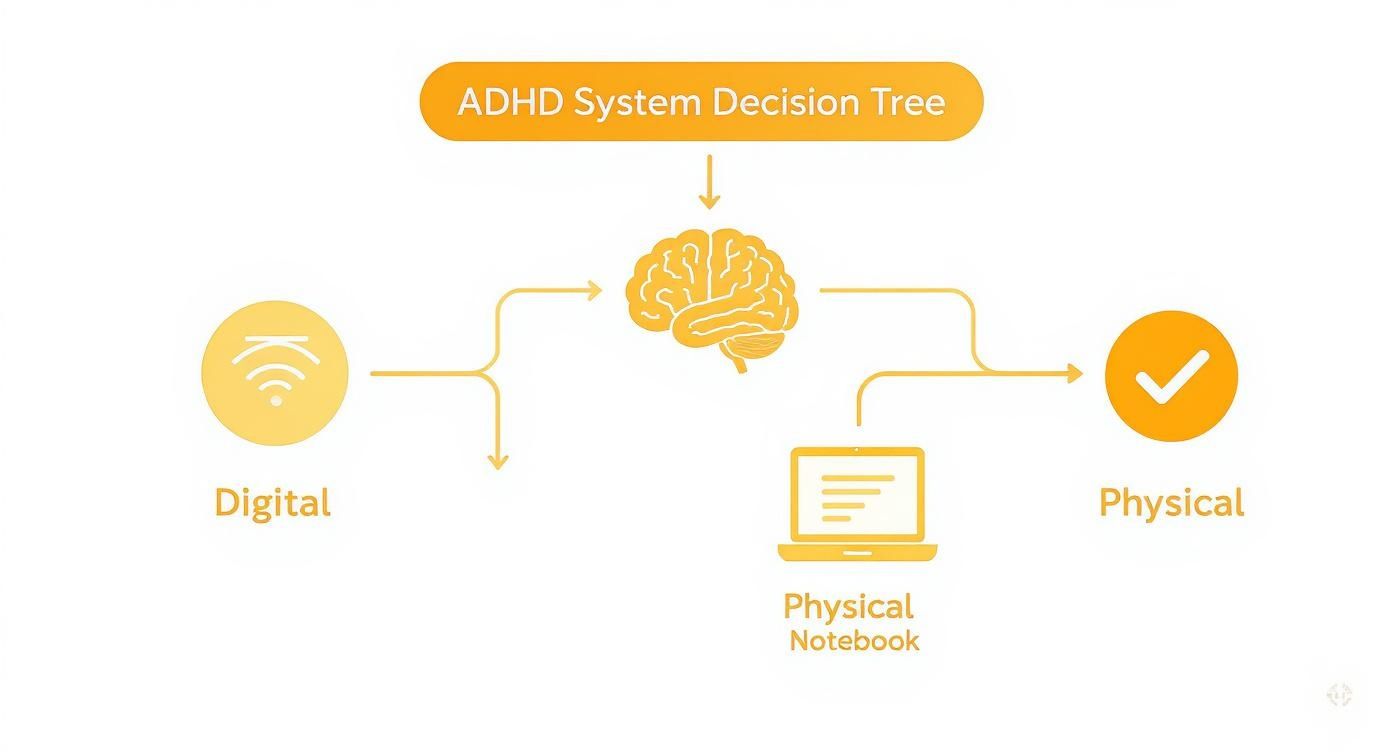
Ultimately, it doesn’t matter if you’re using a fancy app or a spiral notebook. The best tool is the one you’ll actually use consistently.
Slaying the “Monster” Projects
Okay, but what about those giant, overwhelming projects? The ones so big and intimidating they don’t even make it onto your 1-3-5 list because you have no idea where to even start.
The secret is to break them down into almost ridiculously small pieces. I’m not talking about adding “write report” to your list. I mean “open a new Word doc and give it a title.” That’s it. That’s the task.
This approach—sometimes called “atomic tasking”—lowers the barrier to entry so much that your brain doesn’t have time to put up a fight.
Here’s how it works in practice:
- Name the Monster: Pick that one huge thing that’s been hanging over your head. Let’s say it’s “File my taxes.”
- Find the First Tiny Step: What is the absolute next physical action you need to take? It’s not “gather documents.” It’s probably more like, “Find the folder labeled ‘Taxes 2024’ in the filing cabinet.”
- Put Only That Step on Your List: Your to-do item for today isn’t “do taxes.” It’s “find tax folder.”
By focusing only on the very next, tangible action, you sidestep the overwhelm that keeps you frozen. Once you’ve found the folder, the next step (“put folder on desk”) feels easy. And then the next. Suddenly, you’ve tricked yourself into starting, and that’s often the hardest part.
Using Timeboxing to Conquer Procrastination

If you’ve ever stared at a huge task and felt completely stuck—a classic case of “analysis paralysis”—then making time feel real is the answer. This is where timeboxing becomes a game-changer for adults with ADHD. It’s one of the most powerful strategies out there because it directly combats time blindness.
Instead of seeing a project as some vague, endless mountain to climb, you put it in a box. You decide upfront exactly how much time you’re going to spend on it, and that’s it. This simple shift changes the goal from “finish this terrifying report” to something much more doable: “work on this report for 25 minutes.” That small change can be all it takes to lower the mental barrier and just get started.
How to Make Timeboxing Actually Work for You
You’ve probably heard of the most famous timeboxing method: the Pomodoro Technique. It’s built around short, focused bursts of work (usually 25 minutes) followed by short breaks. This works brilliantly for the ADHD brain because it injects novelty, provides clear structure, and doles out frequent little rewards (the breaks!).
A typical Pomodoro-based workflow is beautifully simple: you work until the timer goes off, then you get a break. The visual countdown makes time tangible, which helps you stay locked in until your next scheduled rest.
For a great example on your Mac, you can explore our detailed guide on the Chronoid Pomodoro Timer to see how it can plug into a bigger productivity system. But remember, this isn’t just about setting a timer. It’s a complete cycle, and the breaks are just as critical as the focus sprints. They give your brain a chance to reset so you can come back fresh.
Making Your Breaks Count
What you do during your break is what makes or breaks your next focus session. Let’s be honest, mindlessly scrolling social media feels like a break, but it often just drains your attention even more. A truly effective break is a real mental reset.
Here are a few ADHD-friendly ideas for your five-minute window:
- Get Moving: A few quick stretches, a walk around the room, or even some jumping jacks can burn off that restless energy.
- Refuel: Grab a glass of water or a quick, protein-heavy snack. Your brain needs fuel.
- Change Your View: Step outside for a minute of fresh air, look out a window, or just move to a different room.
- Do a “Micro-Tidy”: Spend five minutes putting just a few things away. It gives you a quick win and clears your physical space, which helps clear your mental space.
The secret to timeboxing is that it gives you permission to stop. You don’t have to finish the entire thing. You just have to finish the time block. That freedom from pressure is often what makes it possible to start in the first place.
This kind of structured approach is especially crucial at work. A staggering 87% of adults with ADHD in the workforce report significant career struggles tied to focus, organization, and time management. These challenges can stall careers, which is why tailored strategies like timeboxing aren’t just “nice to have”—they’re essential. You can find more insights on how ADHD impacts career outcomes and see why these systems are so important.
Customize Your Time Blocks
The classic 25-minute work / 5-minute break cycle is a fantastic starting point, but it’s not set in stone. The best time management for ADHD adults is always flexible. You have to listen to your own brain and energy levels on any given day.
Some days, 25 minutes might feel like an impossible marathon. On those days, try a 15-minute sprint with a 3-minute break. Other days, you might hit a flow state where a 45-minute block with a 10-minute break feels perfect.
The key is to experiment. Find the rhythm that works for you today. By making the technique your own, you turn it from a rigid rule into a flexible tool that supports your brain exactly how it needs to be supported.
Creating Sustainable Routines and Accountability

If you have ADHD, consistency can feel like the final boss in a video game you just can’t beat. You might design the perfect system, stick with it for a glorious week, and then…poof. It’s gone. This isn’t a moral failing or a lack of willpower; it’s a classic ADHD trait. Our brains crave novelty and struggle to get started on tasks, which makes rigid routines a nightmare to maintain.
The secret to long-term success in time management for ADHD adults isn’t about finding a foolproof system. It’s about building an ecosystem for yourself—one that’s simple, forgiving, and supported by a solid accountability net. Think of it less like a prison of rules and more like a supportive scaffold.
Bookend Your Day With Simple Routines
Forget trying to reinvent your entire day from scratch. That’s a recipe for overwhelm. Instead, just focus on creating simple, predictable “bookends” for your day: a morning and an evening routine. These short sequences of actions create much-needed structure, signaling to your brain when it’s time to get going and when it’s time to power down.
And I mean simple. A morning routine doesn’t need to be some two-hour marathon of journaling, meditating, and running five miles. It could literally just be:
- Drink a glass of water.
- Take your meds.
- Glance at your top priority for the day.
That’s it. You’ve started. These tiny, repeatable actions slash the decision fatigue that hits hard in the morning, a time when our executive functions are often still booting up.
The Power of Habit Stacking
So, how do you make these new micro-routines stick? The best trick I’ve found is called habit stacking. The idea is to piggyback a new habit you want to build onto an old, automatic one you already do without a second thought.
If you make coffee every single morning, that’s your anchor. It’s a habit that’s already wired into your brain. You just “stack” the new habit right on top of it.
Instead of trying to forge a new path in your brain, you’re just adding a little extension to a well-worn highway. It dramatically lowers the mental energy needed, which is a total game-changer for us.
Here’s what this looks like in the real world:
- Your Goal: Actually look at your calendar each day.
- The Stack: “Right after I pour my coffee, I will open my calendar app.”
- Your Goal: Keep your desk from becoming a disaster zone.
- The Stack: “As soon as I shut down my laptop for the day, I will set a 10-minute timer and tidy my desk.”
This brilliant little technique removes the “when should I do this?” guesswork. You’re not waiting for a burst of motivation; you’re letting an existing behavior trigger the next one. It’s a profoundly effective way to build consistency without relying on sheer willpower.
Finding Accountability That Actually Helps
For many of us with ADHD, the word “accountability” is loaded. It often sounds like a setup for shame and judgment. We’ve all had that person ask, “Did you do that thing?” in a tone that makes you want to crawl under a rock.
But true accountability is about support, not scrutiny. The goal is to find some external encouragement that adds just a bit of positive pressure.
Here are a few ADHD-friendly ways to do it:
- Body Doubling: This is the magic of simply working with someone else around, whether in person or on a video call. Their quiet presence can be incredibly focusing, even if you never say a word to each other. Tools like Focusmate are designed for this, but even just calling a friend to work in silence can do the trick.
- Accountability Partners: Team up with a non-judgmental friend (bonus points if they also have ADHD) for quick, daily check-ins. You don’t need a detailed report—just state your top priority for the day. Saying it out loud to another human makes it feel more real and urgent.
- Scheduled Check-ins: If you’re on a team at work, ask for more frequent, low-stakes check-ins with your manager. Having to give a quick update every other day creates natural deadlines that are much easier to manage than one massive deadline looming weeks away.
The right kind of accountability provides the external structure our brains often can’t create on their own. It’s what helps you cross the canyon between knowing what you need to do and actually doing it.
Common Questions About ADHD Time Management
Even with the best system in the world, you’re going to hit roadblocks. It’s just part of the deal. ADHD brains thrive on novelty and can get completely derailed by a single interruption or a task that takes longer than expected.
Let’s walk through some of the most common hurdles you’ll face and talk about practical, shame-free ways to get back on track.
What If My New System Stops Working?
This is going to happen. I can almost guarantee it. The new, shiny system that felt so exciting a few weeks ago can suddenly feel like a chore. That’s not a sign of failure—it’s a sign that your brain is ready for a change.
Think of your strategies as a toolkit, not a permanent prison.
When one tool starts to feel stale, just swap it out for another. Maybe you ditch your digital app for a paper planner for a month. Or you could try a different Pomodoro timer or experiment with a new daily priority list format.
The core principles—getting tasks out of your head, seeing your priorities visually, and working in short, focused bursts—stay the same. You’re just changing the specific tool you use to apply them. The real goal is to have a handful of trusted methods you can rotate through to keep things feeling fresh and keep your brain engaged.
How Do I Handle Constant Interruptions?
Dealing with interruptions means being proactive. You can’t just hope they won’t happen; you have to plan for them. A great first step is creating clear physical and digital signals to the people around you.
- Noise-canceling headphones are the universal sign for “I’m in the zone.” They work even if you’re not listening to anything.
- Set your status on work chat apps like Slack or Teams to “Focusing” or “Heads Down.”
- Have a polite but firm script ready for in-person interruptions. Something as simple as, “Hey, I’m deep in a focus block for the next 45 minutes. Can we connect after that?” works wonders.
But let’s be honest: the biggest source of interruptions is often our own brain. Keep a “distraction pad” (a physical notepad or a digital note) right next to you. When a random thought or brilliant new idea pops into your head, just jot it down to deal with later and immediately return to your task.
I Am Terrible at Estimating How Long Tasks Take
You’re not terrible; you’re just experiencing “time blindness,” a classic feature of ADHD. The only way to get better at this is to stop guessing and start gathering real data. Become your own time scientist.
For just one week, actively time your most common tasks. When you start clearing your inbox, start a timer. When you stop, stop the timer. Do this for everything, from writing reports to making lunch. You’ll be surprised at how quickly you build a realistic picture of how long things actually take versus how long you think they should.
When you’re planning your day, use this data. A simple and incredibly effective rule is to take your initial estimate and double it. If you think a task will take 30 minutes, block out a full hour. This buffer is a lifesaver—it reduces the anxiety of running behind and gives you a realistic cushion for those small, inevitable distractions.
For more ongoing advice and deeper dives into productivity techniques, you can often find helpful resources on the Taskignite blog.
Ready to stop guessing where your time goes and get real data on your focus patterns? Chronoid automatically tracks your app and website usage, providing clear insights without manual timers. Discover your most productive hours, block distractions, and build a workflow that supports your brain. Start your free 7-day trial of Chronoid today.