
Focus and productivity rise and fall together: the hours you spend at your desk only turn into finished work when your attention stays on one thing. To really improve your focus at work, you have to fight a war on two fronts: stamping out external interruptions and getting a handle on your internal distractions. This means taking control of your environment, using smart methods like time blocking, and truly understanding the mental price you pay every time you switch tasks.
Why You Struggle to Focus at Work (and What It Costs Your Productivity)
If you feel like your concentration is constantly being shattered into a million pieces, you’re not just imagining it. The modern workplace seems almost perfectly engineered to sabotage our focus. Every ping from Slack, every “got a quick question?” from a coworker, and every last-minute meeting yanks your brain in a new direction. It can make deep, meaningful work feel completely out of reach.
This isn’t just a feeling—it’s a real, measurable drain on your cognitive resources. Each time you jump from one thing to another, like pausing a detailed report to fire off an email, you’re “context switching.” Your brain has to dump all the information related to the first task and then load up an entirely new set of information for the second. This mental gear-shifting burns a surprising amount of time and energy.
The Real Cost of Interruptions
That constant stream of distractions is far more destructive than most people realize. In The Cost of Interrupted Work (Mark, Gudith & Klocke, CHI 2008), researchers shadowing office workers found it took an average of roughly 23 minutes to return to an interrupted task. Do the math — a few “quick” interruptions can easily vaporize an hour of real work.
And it’s not just other people. We’re often our own worst enemies, interrupting ourselves to check social media, glance at the news, or just switch tasks because we’re bored. For some, this internal pull is even stronger due to conditions like ADHD, which creates unique focus challenges but also responds well to specific strategies like time management for ADHD adults.
The fundamental problem isn’t a lack of willpower. It’s that our work culture is built on the myth of instant availability. We’ve trained ourselves to believe that being responsive is more valuable than being productive, and it’s left us in a state of continuous partial attention.
More Than Just Mental Fatigue
It’s not all in your head, either. Physical discomfort is a massive, often overlooked, focus-killer. Staring at a screen for hours on end can easily lead to headaches, blurry vision, and a general feeling of being drained. Learning the symptoms of digital eye strain and how to find relief is a critical step toward building a sustainable work routine.
Once you start to pinpoint exactly what—and who—is stealing your attention, you can finally begin to build a defense that works for you.
Designing Your Distraction-Free Workspace
Your immediate environment has a huge—and often underestimated—impact on your ability to concentrate. It can either be a sanctuary for deep, meaningful work or a minefield of constant distractions. If you’re serious about improving your focus, creating a space that actively supports it isn’t just a nice-to-have; it’s essential.
This isn’t just about your physical desk. It’s about taking a hard look at your digital world, too. A messy desk and a cluttered desktop both create a low-grade hum of mental static, quietly pulling your attention away from what truly matters. Our goal is to silence that static so you can free up all your mental energy for the task at hand.
The image below really nails down the three biggest culprits that derail our workdays.
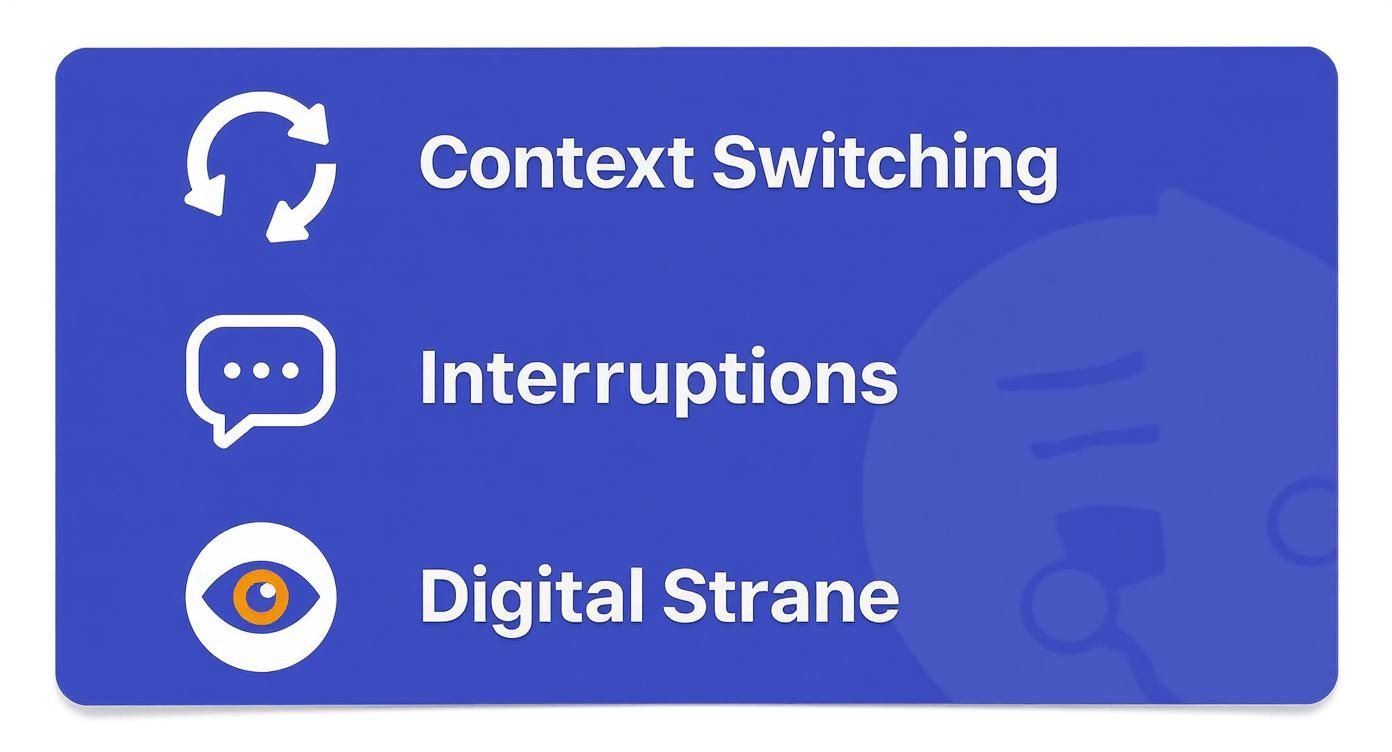
As you can see, the combination of constant context switching, endless interruptions, and digital overload is a perfect storm for killing our ability to concentrate.
Taming Your Digital Environment
Let’s be honest: your computer is probably the loudest source of interruptions you face all day. Those endless pings from email, chat apps, and social media are literally designed to hijack your attention. The first step to reclaiming your focus is a digital declutter.
Here are a few things you can do right now:
- Go silent. Turn off all non-essential notifications on your computer and phone. Seriously, all of them. Instead of reacting to every new message, schedule a few specific times throughout the day to check in.
- Block temptation. This is where tools like Chronoid’s built-in website blocker really shine. Set it up before you start a deep work session to put a hard stop on your go-to procrastination sites. No willpower required.
- Clean your screen. Keep your desktop tidy, with only the apps and files you need for your current project visible. A chaotic screen leads to a chaotic mind.
By making a conscious effort to control what you see and hear from your devices, you’re not just getting rid of distractions. You’re sending a powerful signal to your brain: “It’s time to focus.”
Optimizing Your Physical Space
Your physical surroundings play a massive role in your mental state. You don’t need a total office makeover; a few smart adjustments can signal to your brain that it’s time to get down to business.
Below is a quick comparison to help you tackle distractions on both fronts.
Digital vs Physical Workspace Optimization
| Focus Area | Digital Optimization | Physical Optimization |
|---|---|---|
| Noise Control | Silence all non-essential notifications and alerts. | Use noise-canceling headphones; find a quiet area. |
| Visual Clutter | Clean up your desktop and close unused tabs. | Keep your desk clear of anything not related to your task. |
| Access & Boundaries | Use app and website blockers (Chronoid is great for this). | Arrange your desk to face a wall; use partitions if needed. |
| Task Management | Use a single, focused to-do list application. | Have physical tools (notebook, pens) within easy reach. |
| Comfort & Health | Use blue light filters; take screen breaks. | Adjust your chair and monitor for proper ergonomics. |
These small tweaks add up, creating an environment that encourages focus rather than fights against it.
For those in a busy open office, noise can be the biggest focus-killer. A good pair of noise-canceling headphones is one of the best investments you can make. And if you’re in a cubicle, finding ways to create a sense of privacy is key. Check out these practical cubicle privacy strategies for better focus for some great ideas on how to minimize visual and auditory interruptions.
Even small, simple changes can have a powerful effect:
- Organize your desk. Follow the “a place for everything” rule. A tidy desk reduces visual noise and kills the urge to fidget with random stuff.
- Let there be light. Bad lighting is a recipe for eye strain and fatigue. Try to use natural light when you can, or get a good desk lamp to properly light up your workspace.
- Don’t forget ergonomics. An uncomfortable chair or a monitor at the wrong height is a constant, nagging distraction. Get your setup adjusted so you can work comfortably for longer stretches.
Using Time Blocking to Master Your Day
If you want to improve your focus at work, you have to stop letting your calendar run your life. Instead of just reacting to whatever comes your way, time blocking lets you take control and decide ahead of time what truly matters. This isn’t about creating a rigid, back-to-back schedule. It’s about building a fortress around your most important work.

The idea is simple: treat your high-priority tasks with the same respect you’d give a meeting with your CEO. You find an open slot on your calendar and block it off for a specific task. No interruptions allowed. This small act turns a vague “to-do” into a concrete commitment you’re far more likely to keep.
The Pomodoro Technique: A Gateway to Deep Work
One of the best entry points into time blocking is the Pomodoro Technique. It’s built on a beautifully simple rhythm: work in focused 25-minute sprints, then take a short 5-minute break. After four of these cycles, you reward yourself with a longer break, maybe 15-30 minutes.
The magic of this technique is that it makes even the most daunting tasks feel manageable. Instead of staring down a three-hour project, you just have to commit to 25 minutes of focused effort. It almost gamifies your work, helping you build up your focus muscle over time. For many people, it’s the perfect on-ramp to developing a real deep work habit.
This kind of structure is incredibly powerful, especially with so many of us working flexibly. When nobody else is setting the boundaries of your day, the blocks you draw yourself are the only ones there are — which is exactly why remote and hybrid workers tend to feel the absence of structure faster than office workers do.
Adapting Time Blocks to Your Role
Time blocking isn’t a one-size-fits-all solution. A software developer and a project manager have completely different daily rhythms, so their calendars should reflect that.
- For the Developer (Maker’s Schedule): A developer needs long, uninterrupted stretches to get into a flow state and solve complex problems. Their calendar might have two or three 90-minute “deep work” blocks for coding, with shorter chunks of time for things like code reviews or team syncs.
- For the Manager (Manager’s Schedule): A manager’s day is often sliced up by meetings and constant communication. They can still time block by “batching” similar tasks. For example, setting aside a 60-minute block just for answering non-urgent emails or scheduling all one-on-one meetings on the same afternoon.
The trick is to identify and protect your most mentally draining work. Using a simple framework like the time management quadrant to clarify your priorities can help you figure out exactly what deserves a dedicated block in your schedule.
Create a Pre-Focus Ritual
How you start a focus session is just as important as the session itself. A pre-focus ritual is a short, consistent routine that acts as a signal to your brain that it’s time to get serious. Think of it as a warm-up for your mind.
Your ritual doesn’t need to be complicated. It’s a simple, repeatable sequence that transitions you from a state of distraction to one of deep focus, making it easier to drop into a productive flow state.
Here’s a simple three-step ritual you could try:
- Clear Your Space: Tidy up your desk and close out all the browser tabs that aren’t related to your task. Put your phone on silent and move it out of arm’s reach.
- State Your Intention: Grab a sticky note and write down the single most important thing you want to accomplish in this block.
- Start Your Timer: Fire up a timer to officially begin. A tool like Chronoid’s built-in Pomodoro timer is perfect for this.
This small routine creates a powerful psychological cue. After a while, your brain will start to associate these specific actions with deep concentration, making it much easier to drop into a state of flow whenever you need to.
Connecting Well-Being and Concentration
Let’s be honest: you can’t brute-force your way to focus. If your brain and body are running on fumes, willpower alone won’t get you through that big project. A truly productive day is built on a foundation of well-being.
When you’re stressed, anxious, or creeping toward burnout, your cognitive resources—the very things you need for deep concentration—are the first to go.
Pushing through mental fatigue is like trying to drive a car with the gas light on. You won’t get far, and you’ll probably do some damage along the way. Learning how to improve focus at work often means stepping away from the desk to recharge your batteries. This isn’t a weakness; it’s a smart strategy for sustainable performance.

This idea isn’t just a hunch; it’s a major shift in the modern workplace. A recent Mercer survey found that 71% of employees now value mental health benefits like counseling services more than they do traditional office perks. It’s a clear sign that we’re finally understanding how much emotional well-being fuels our ability to concentrate. You can find more of these insights in this great breakdown of employee well-being trends on JoinAssembly.com.
Manage Your Mental Energy, Not Just Your Time
Thinking about your day in terms of energy instead of hours is a complete game-changer. The real goal isn’t just to manage 8 hours; it’s to protect and replenish your mental energy throughout those hours. Your best tool for this? Strategic breaks.
And I don’t mean just scrolling through your phone. A real break is an intentional disengagement that gives your brain a chance to actually rest and reset.
- Move Your Body: Even a five-minute walk around the office or a few stretches at your desk can get blood flowing to your brain, making you feel more alert.
- Get Some Sunlight: If you can, step outside for a few minutes. Natural light is a powerful regulator for your internal clock, which has a huge impact on your energy and mood.
- Practice Mindful Disconnection: Find a quiet corner, close your eyes, and just focus on your breathing for two minutes. This simple act can cut through stress and clear out some of that mental clutter.
The trick is to take a break before you feel completely drained. Proactive, scheduled rest is way more effective for maintaining high-quality focus than waiting until your tank is empty.
The Simple Foundations of Focus
Sometimes the most effective focus aids are the most basic ones—and they’re the ones we tend to forget. Overlooking these fundamentals can sabotage your concentration before your workday even gets going.
Stay Hydrated Your brain is about 75% water. Even mild dehydration can mess with your cognitive function, leading to brain fog, fatigue, and a serious dip in concentration. The easiest fix is to keep a water bottle on your desk and sip it throughout the day. Don’t wait until you’re thirsty.
Desk-Friendly Mindfulness You don’t need a yoga mat or a silent room to practice mindfulness. Try the “5-4-3-2-1” grounding technique right where you’re sitting. Silently name five things you can see, four things you can feel, three things you can hear, two things you can smell, and one thing you can taste. This simple exercise yanks your attention back to the present moment, calming a racing mind so you can tackle your next task.
Finding the Right Tools to Support Your Focus
Technology is a double-edged sword. It’s often the biggest source of our distractions, but it can also be your best ally in the battle for deep work. The trick is to be deliberate, picking tools that build a fortress around your attention instead of just adding more digital noise.
Think of these apps less like magic wands and more like training wheels for your concentration. They help you enforce the new habits you’re building, making it far easier to stay on track until focused work starts to feel like second nature. A tool is only as good as the strategy behind it.
Building Your Digital Focus Toolkit
Your goal isn’t to download a dozen new apps. It’s to assemble a small, powerful suite of tools that solve your specific focus problems and fit neatly into your existing workflow.
Here are the essential categories I always recommend people start with:
- Focus Timers: This is your foundation. Tools like the timer built into Chronoid are perfect for structured methods like the Pomodoro Technique. They give you a clear start and stop for your work sessions and, just as importantly, remind you to step away and recharge.
- Website and App Blockers: Let’s be honest: willpower runs out. A good blocker app removes the temptation entirely. It makes it physically impossible to drift over to Twitter or a news site when you’re supposed to be in a focus block. For anyone who battles self-interruption, this is non-negotiable.
- Ambient Noise Generators: Silence can be surprisingly distracting. An ambient sound app provides a steady, unobtrusive audio backdrop—like rainfall or the low hum of a coffee shop—that can drown out distracting office chatter and help you slip into a state of flow.
- Minimalist Task Managers: A sprawling, chaotic to-do list is a huge source of anxiety. A simple task manager lets you offload that mental checklist so you can pour all your energy into the one task in front of you without the nagging fear you’ll forget something important.
Getting the right mix for your computer is key. For example, if you’re on a Mac, you’ll want tools that are built for it. You can explore some great options in this guide to the best productivity apps for Mac.
The Rise of AI-Powered Focus Assistants
We’re now seeing a new wave of tools that are much smarter than simple timers and blockers. To really improve your focus, it’s worth looking for AI that assists your concentration rather than fracturing it — a tool that summarizes where your attention actually went is working for you, while one that interrupts you with suggestions is just another notification source wearing a different hat.
An effective focus tool doesn’t just block distractions; it helps you understand them. It gives you insights into your own patterns, showing you when you’re most productive and what consistently pulls you off track.
This is where intelligent apps like Chronoid really shine. By automatically tracking how you spend your time on your computer, they give you an objective, data-backed picture of where your attention is actually going. This clarity allows you to make smart adjustments to your habits and your toolkit, building a personalized focus strategy that truly works for you.
Got Questions About Improving Your Focus? We’ve Got Answers.
Putting all these focus strategies into practice is one thing, but what happens when you hit a real-world snag? It’s bound to happen.
Let’s walk through some of the most common questions and challenges I hear from people trying to get a better handle on their attention at work. Think of this as your go-to troubleshooting guide.
How Long Does It Really Take to See a Difference?
You can get a quick win almost immediately. Just silencing your notifications for an hour will feel like a breath of fresh air. But building deep, lasting focus? That’s more like training for a marathon than a sprint—it takes consistent effort.
Most people tell me they feel a real, noticeable shift in their ability to concentrate for longer stretches within about two to four weeks of consistent practice with techniques like time blocking and fending off interruptions.
The secret isn’t intensity; it’s consistency. A solid 30 minutes of focused practice every day will do more for you than a single, heroic three-hour deep work session once a week. The more you do it, the easier it gets to slip into that coveted flow state.
What If My Job Is Basically One Big Interruption?
This is a big one, especially for managers, customer support leads, or anyone whose job is to be available. In these roles, you can’t just build a wall around yourself. The goal isn’t to eliminate interruptions entirely—that’s just not realistic. It’s about managing them so they don’t run your day.
The trick is to set clear boundaries and manage expectations.
- Set Up “Office Hours”: Block out specific times on your calendar when your team knows you’re available for questions. This trains them to save non-urgent things for those windows.
- Lean on Your Status: A simple “Focusing” or “Deep Work” status in your chat app works wonders. It’s a polite but firm signal to think twice before pinging you.
- Batch Your Communications: Don’t reply to every email or message the second it arrives. Instead, set aside a few short blocks per day to clear your inbox and respond to chats all at once.
Even if you can only carve out two 45-minute focus blocks a day, you’ll be amazed at how much you can accomplish on your most important work.
I Tried Pomodoro and Hated It. Now What?
You’re not alone. The Pomodoro Technique is a great entry point, but it’s definitely not a one-size-fits-all solution. For many people, especially on creative or technical tasks, that 25-minute timer goes off right as they’re hitting their stride, which is incredibly frustrating.
If it’s not clicking for you, don’t force it. Try one of these alternatives instead:
- The Flowtime Technique: This is my personal favorite for creative work. You just work on one task for as long as you feel focused, then take a break that’s proportional to how long you worked. No jarring timers.
- 90-Minute Focus Blocks: This approach is grounded in our natural energy cycles, or ultradian rhythms. Research suggests our brains are wired to focus intensely for about 90 minutes, followed by a need for a 20-minute break.
Ultimately, the best method is the one that feels natural for you and your type of work. Give yourself permission to experiment and find what fits.
Ready to stop guessing where your time is going and start building a workday you can be proud of? Chronoid automatically tracks your activity, giving you a crystal-clear, data-driven look at your habits. Use its powerful insights and built-in focus tools to finally get a handle on distractions and master your attention.
Start your free 7-day trial and see what a difference real data can make.