
The time management quadrant is a simple grid that helps you sort your tasks by two critical factors: urgency and importance. The whole point is to help you move beyond just putting out fires and start focusing on what will actually move the needle for you long-term. It forces you to look at your to-do list and sort everything into one of four boxes.
From Busy to Productive: Why Your To-Do List Needs a Filter

Ever feel like your workday is just a mad dash to the finish line? You’re bouncing between urgent emails, hopping from one meeting to the next, and dealing with a constant stream of interruptions. By 5 p.m., you’re completely wiped, but those big, important projects are still sitting right where you left them. This is the classic trap of being busy instead of being productive.
So many of us mistake activity for actual achievement. We get stuck in a reactive mode, letting our day be shaped by other people’s priorities instead of our own. It’s like being a firefighter who’s so busy putting out small trash can fires that they never get around to fireproofing the building.
The Problem with Unfiltered Busyness
When you don’t have a way to filter your tasks, everything starts to feel like a top priority. This is a fast track to overwhelm, where you’re being pulled in a million directions at once. Living in this constant state of reaction comes with some serious costs:
- Increased Stress and Burnout: Constantly juggling urgent demands is a recipe for chronic stress, which is the main ingredient for burnout.
- Lack of Progress on Key Goals: The truly important stuff—the long-term goals that shape your career—is rarely urgent. So, it gets shoved aside for whatever is screaming the loudest.
- Decreased Work Quality: When you’re constantly switching gears, you never get into that state of deep focus required to do your best, most creative work.
The real problem isn’t a lack of time. It’s the lack of a clear system for deciding where your time should go. When you just react to the loudest noise, you’re essentially handing over control of your own success.
This is where the time management quadrant comes in. It’s a simple, but incredibly effective, framework for taking back control. It gives you a way to pause, evaluate every task on your plate, and intentionally put your energy into the things that deliver real, lasting value. It’s your first step to getting off the hamster wheel for good.
What Is the Time Management Quadrant, Really?
At its heart, the Time Management Quadrant is a decision-making grid. It’s a surprisingly simple tool that helps you sort everything on your plate using just two criteria: urgency and importance. Think of it as a lens for your to-do list, making sure you put your energy into what truly matters.
So what’s the difference? Urgency is all about the clock. An urgent task demands your attention right now. It has a deadline breathing down its neck and consequences if you ignore it. Importance, on the other hand, is about value. An important task is one that moves you closer to your long-term goals and aligns with what you care about, both at work and in life.
The Two Sides of Every Task
The magic of this whole system is realizing that urgent and important are not the same thing. Not even close.
That phone ringing off the hook? That’s urgent, but the conversation itself might be completely unimportant. Mapping out your career goals for the next five years is incredibly important, but it almost never feels urgent.
Understanding this difference is how you break free from the “busy trap” and start being genuinely productive. By placing your tasks on a four-square grid—with urgency on one axis and importance on the other—you get a crystal-clear picture of what you should be doing.
“I have two kinds of problems, the urgent and the important. The urgent are not important, and the important are never urgent.” - Dwight D. Eisenhower
This quote, often credited to Eisenhower, gets right to the heart of the daily struggle we all face. If we don’t have a system, we’re hardwired to jump on whatever is making the most noise, not what will make the biggest difference.
From a President’s Idea to a Practical Tool
While Dwight D. Eisenhower planted the seed for this idea, it was Stephen Covey who made it a household name. In his groundbreaking book, The 7 Habits of Highly Effective People, he introduced it as the “Time Management Matrix” and turned a simple observation into a system anyone could use.
And it works. One study of 500 professionals who started using the matrix found they felt dramatically more in control of their workday. That feeling comes from making a deliberate shift from being reactive (putting out fires) to proactive (building the future). You can dive deeper into the impact of the 4 quadrants of time management on Timebee’s blog.
The quadrant gives you a visual map of your priorities. It forces you to stop and ask two quick questions before you start any task: Is this urgent? And is it important? Your answers will point you to one of four quadrants, and each one has a specific playbook. We’ll break those down next, but just building this habit is the first step to taking back your focus.
A Practical Breakdown of the Four Quadrants
To really get a handle on the time management quadrant, you have to understand the unique personality of each section. Think about it: every single task on your to-do list, from a client emergency to mindlessly scrolling through your phone, fits neatly into one of these four boxes.
Let’s dig into them with some real-world examples to see where your time is actually going.
The whole system hangs on two simple questions: Is it urgent? And is it important? How you answer sorts everything on your plate.
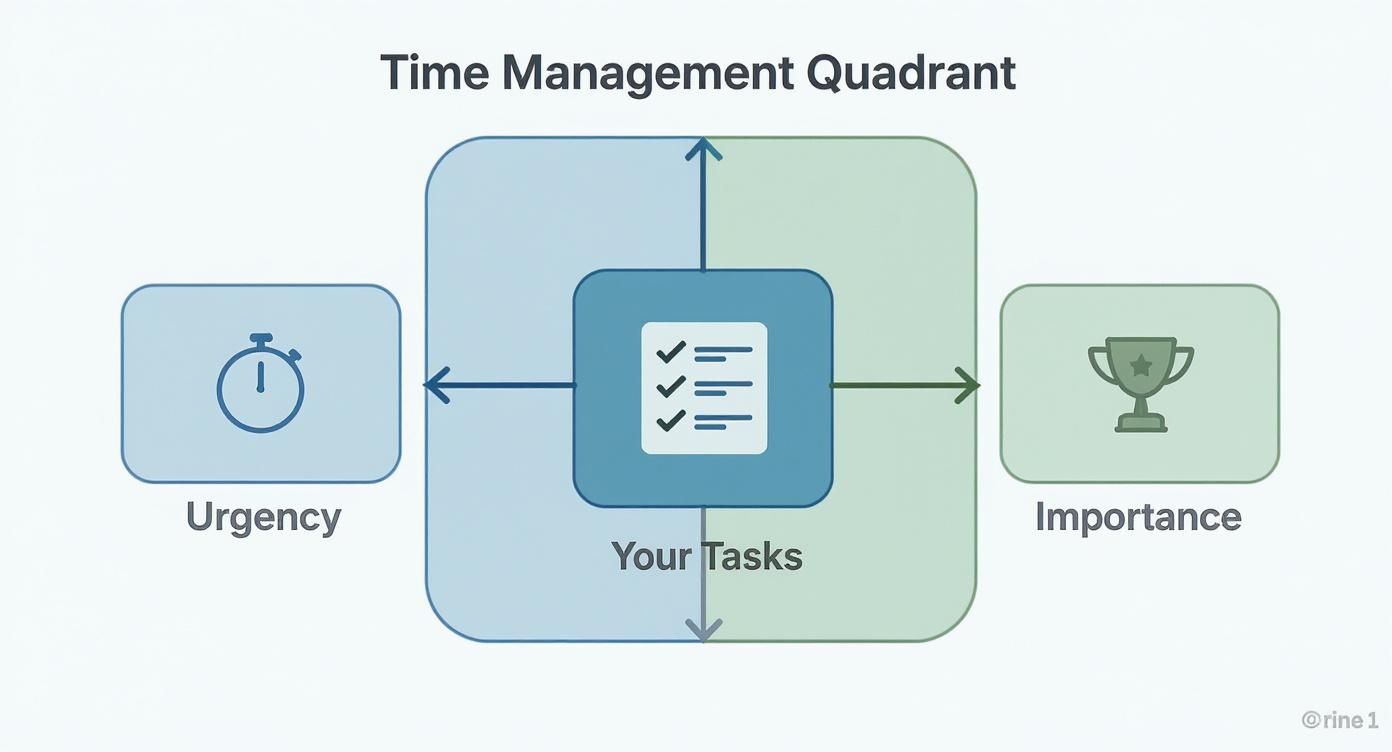
This grid is your new best friend for deciding whether to do something immediately, schedule it for later, hand it off, or just drop it altogether.
Quadrant 1: The Do Zone
This is the quadrant for anything that is both Urgent and Important. These are your crises, your pressing problems, and your absolute, must-hit-today deadlines. You can’t put them off—they demand your immediate attention. Welcome to the “firefighting” zone.
Living in Quadrant 1 is a recipe for stress and burnout. While you can’t get rid of these tasks completely, the real goal is to shrink this quadrant by spending more quality time in Quadrant 2.
- Example Tasks:
- Handling a major client complaint that just came in.
- Finishing a project proposal due by the end of the day.
- Dealing with a sudden family emergency.
The action for Quadrant 1 is simple: Do it now. These tasks are your absolute top priority, but a day packed with them is a sure sign you’re reacting to your schedule instead of controlling it.
Quadrant 2: The Decide Zone
This is where the magic happens. Quadrant 2 is for tasks that are Important, but Not Urgent. This is home to strategic planning, relationship-building, and professional growth—all the high-impact work that stops future crises from ever happening.
The tricky part? Because these tasks don’t have a screaming deadline attached, they’re incredibly easy to push off. But making a real effort to invest time here is the single best thing you can do for your long-term success and well-being.
- Example Tasks:
- Planning your goals for the upcoming quarter.
- Learning a new skill that will help you advance your career.
- Exercising and focusing on preventative health.
The action here is to Decide when to do it. Get these activities on your calendar and guard that time like a hawk. This is where you make real, meaningful progress.
Quadrant 3: The Delegate Zone
Welcome to the zone of deception. Quadrant 3 is filled with tasks that are Urgent, but Not Important. These are the constant interruptions that masquerade as productive work but do absolutely nothing to move you toward your long-term goals. They’re usually someone else’s priorities dressed up as yours.
It’s so easy to get stuck here, mistaking the urgency for actual importance. Learning to spot these tasks and push back is the key to freeing up your time for what really matters.
- Example Tasks:
- Responding to non-critical emails and messages the second they pop up.
- Sitting through meetings you don’t really need to be in.
- Handling routine administrative requests from colleagues.
The best action plan here is to Delegate. If you can’t pass a task on to someone else, try to automate it or batch similar tasks together to keep them from derailing your day.
Quadrant 4: The Delete Zone
And finally, we have Quadrant 4: Not Urgent and Not Important. These are the time-wasters, the mindless distractions, and the bad habits that offer zero value. They feel easy in the moment but almost always leave you with a sense of regret.
Spending any significant time here is a direct drain on your energy and focus. The only way to win is to be ruthless and cut these activities out as much as possible.
- Example Tasks:
- Mindless social media scrolling.
- Binge-watching a show you aren’t even enjoying.
- Sorting through junk mail or organizing old files that serve no purpose.
The only action for Quadrant 4 is to Delete it. Recognize these activities for the time-sinks they are and consciously cut them out of your routine.
To make this even clearer, here’s a quick cheat sheet that pulls everything together.
The Four Quadrants of Time Management at a Glance
| Quadrant | Description (Urgency/Importance) | Example Tasks | Action |
|---|---|---|---|
| Quadrant 1 | Urgent & Important | Crises, pressing deadlines, client emergencies | Do Now |
| Quadrant 2 | Not Urgent & Important | Strategic planning, relationship building, new skills | Decide & Schedule |
| Quadrant 3 | Urgent & Not Important | Unnecessary meetings, most emails, interruptions | Delegate |
| Quadrant 4 | Not Urgent & Not Important | Mindless scrolling, time-wasting habits, busywork | Delete |
Keeping this simple framework in mind helps you quickly assess any task that comes your way and make a smart decision instead of just reacting.
Putting the Quadrant into Action Today

It’s one thing to understand a concept, but it’s another thing entirely to make it work for you. The good news is that shifting from theory to reality with the time management quadrant is pretty straightforward. It all begins with getting your massive to-do list out of your head and onto paper where you can actually see it.
The first step? A simple brain dump. Grab a notebook, a blank document, or even a whiteboard and just start writing. List every single task, big or small, that’s currently taking up mental real estate. Don’t worry about organizing just yet—the goal is to get it all out.
With your master list in front of you, it’s time to play sorter. Look at each item and ask two simple questions: Is it urgent? And is it important? Answering these will tell you exactly which of the four quadrants each task belongs in.
A Simple Step-by-Step Sorting Process
You don’t need a complicated system to make this work. Just follow these steps to turn that jumbled list into a clear, actionable plan.
- Identify Quadrant 1 (Do Now): Scan your list for the real emergencies—the genuine crises and hard deadlines. These are your must-do-today items. Mark them as your absolute top priorities.
- Schedule Quadrant 2 (Decide When): Now, find those important tasks that aren’t screaming for your immediate attention. This is where the magic happens: strategic planning, skill development, relationship building. Don’t just leave them on a list; open your calendar and book a specific time to work on them. Guard that time fiercely.
- Contain Quadrant 3 (Delegate or Minimize): Look for the things that feel urgent but aren’t actually important to your goals. These are usually interruptions or someone else’s priorities. Ask yourself: Can I delegate this? Can I automate it? If you’re stuck with it, try batching similar tasks together to knock them out in one go, so they don’t constantly break your focus. A great place to start is learning how to automate repetitive tasks to win back more of your day.
- Eliminate Quadrant 4 (Delete): Take a hard look at what’s left. These are the time-wasters that don’t add any real value. Be honest with yourself and be ruthless—cross them off your list and make a commitment to avoid them.
The goal isn’t to achieve a perfect, empty to-do list overnight. It’s about making conscious, incremental shifts toward spending more of your valuable time and energy in Quadrant 2.
Staying Consistent with Your Quadrants
Here’s an interesting tidbit: a 2022 study found that while only 2% of people formally use the Eisenhower Matrix by name, a whopping 78% already use some of its principles without even knowing it. That gap shows just how much more effective we could be if we were a little more intentional about it. You can find the full details in this time management statistics report.
To make this a habit, try using dedicated work blocks for your Quadrant 2 activities. Techniques like the Pomodoro method are fantastic for this. You can learn more about how to structure these deep work sessions in our guide to the Pomodoro Timer. This simple practice helps you protect your focus and reinforces your commitment to what truly matters.
Common Pitfalls and How to Avoid Them
Putting the time management quadrant into practice is a game-changer, but let’s be honest—like any new habit, it has a few tripwires. If you know where they are, you can step right over them and give the system a real chance to work for you.
One of the biggest traps we all fall into is mixing up what’s urgent with what’s actually important. That phone buzzing on your desk? It feels urgent. But is the call itself truly important to your long-term goals? Our brains are wired to react to the immediate, the noisy, and the new, which yanks us straight into Quadrant 3. It’s the classic trap of mistaking busyness for productivity.
The Adrenaline Rush of Quadrant 1
Another pitfall is getting hooked on the feeling of Quadrant 1. There’s a certain thrill that comes from swooping in to handle a crisis or hitting a last-minute deadline. You feel like a hero putting out fires all day.
But here’s the problem: if you’re always putting out fires, you never get a chance to fireproof the building. Living in Quadrant 1 is a recipe for burnout. If your entire day is a sprint from one emergency to the next, it’s a sure sign you aren’t dedicating enough time to Quadrant 2, where the real planning and prevention happen.
The real danger isn’t the urgent task itself, but the belief that urgency equals value. Breaking this mindset is the first step toward regaining control and focusing on what truly drives long-term success.
Mismanaging Quadrants 3 and 4
It’s just as easy to get tripped up by the lower-value quadrants. A lot of us feel guilty about delegating Quadrant 3 tasks. We think, “It’s faster if I just do it myself.” But that “five-minute task” adds up, and soon your day is fragmented by a dozen small interruptions that kill any chance for deep, focused work.
And then there’s Quadrant 4. We almost never realize how much time we lose here. A quick scroll through social media, a little online window shopping—it all feels harmless. But these distractions are often just our way of procrastinating on the tougher, more meaningful work in Quadrant 2. If you find yourself constantly drifting, it might be time to build better focus habits. Learning how to manage digital distractions is a great place to start.
Here are a few simple ways to steer clear of these common mistakes:
- Pause Before You Pounce: When a new request lands on your plate, take a breath. Ask yourself: “Is this genuinely important, or is it just making a lot of noise?”
- Book Time for Quadrant 2: Literally schedule appointments with yourself for strategic thinking and planning. Then, protect that time like it’s your most important meeting of the week—because it is.
- Delegate with Confidence: Think of delegation not as passing the buck, but as empowering your team while freeing yourself up for the work only you can do.
- Get Good at Saying ‘No’: Be ruthless about eliminating time-wasters. If it doesn’t serve your goals, it doesn’t belong in your day.
Mastering the Quadrant for Long-Term Success
The real magic of the time management quadrant isn’t just about shuffling your to-do list. It’s about a fundamental shift in how you approach your work and life. You want to move from being a firefighter, constantly putting out crises, to being an architect, designing your own success.
That transformation happens when you start living in Quadrant 2.
Making time for the important, non-urgent stuff—like learning new skills, strategic planning, and building strong relationships—is the secret to long-term growth and avoiding burnout. These are the activities that fireproof your future, making sure fewer emergencies ever have a chance to ignite in the first place.
While the quadrant gives you a fantastic roadmap for prioritizing tasks, it’s also smart to think about where your personal energy levels fit in. Looking into ideas like Energy Management vs. Time Management can add another powerful layer to your productivity strategy. In the end, both frameworks point to the same thing: being proactive and intentional with your time.
Your First Step Toward a Proactive Future
You don’t need to completely overhaul your life overnight. This shift begins with one small, simple action that can set the tone for your entire day.
The most effective people are not problem-minded; they’re opportunity-minded. They feed opportunities and starve problems. By focusing on Quadrant 2, you are choosing to feed your biggest opportunities for growth.
Try this: tonight, take just ten minutes to sort tomorrow’s tasks into the four quadrants. This simple habit creates momentum. It ensures you walk into your day with a clear plan, ready to act instead of just react.
This small discipline is one of the most powerful time management best practices you can build. It’s your first real step toward a more intentional, productive, and fulfilling future.
Frequently Asked Questions
You’ve got the basics down, but what happens when the time management quadrant meets the real world? Here are a few common questions that pop up once you start putting this into practice.
What If a Task Is Both Urgent and Important?
This is the classic Quadrant 1 scenario. If you have a critical project deadline breathing down your neck, it’s both urgent and important. The only thing to do is tackle it head-on.
But the real goal here isn’t just dealing with these fires—it’s preventing them. The more time you consistently invest in Quadrant 2 planning and preparation, the fewer tasks will ever escalate into last-minute emergencies. Think of it as preventative maintenance for your schedule.
How Can I Delegate Without a Team?
Great question. If you’re a freelancer or work on your own, “delegation” sounds like a luxury you don’t have. But you can reframe it. Instead of handing tasks off, think about minimizing, automating, or eliminating them.
The key to handling Quadrant 3 is to shrink the time these tasks steal from you. If you can’t pass a task to someone else, find a way to automate it, use a template, or just politely decline requests that don’t align with your goals.
For example, creating canned email responses for common inquiries or blocking out “no meeting” time on your calendar are both forms of delegation—you’re delegating those interruptions to a system you created.
How Often Should I Review My Quadrants?
Consistency is everything. A fantastic habit to build is spending just 10-15 minutes at the end of each day to sort tomorrow’s tasks into your quadrants. This simple ritual ensures you wake up knowing exactly what your priorities are.
Beyond that, a weekly review is a game-changer. It helps you zoom out and see if you’re making real progress on those big-picture Quadrant 2 goals that truly move the needle.
Ready to stop guessing where your time goes and start investing it in what truly matters? Chronoid automatically tracks your work on macOS to give you a clear, visual breakdown of your personal time management quadrant. Start your free 7-day trial of Chronoid today.