
Feeling constantly overwhelmed is a flashing red light on your life’s dashboard. It’s a clear signal that your current systems—or lack thereof—just aren’t cutting it anymore. The only way to start fixing things is to get brutally honest about where your time and energy are actually going. This all begins with a simple diagnostic I swear by: the time audit. It gives you the raw data you need to start making real, intentional changes.
First, Figure Out Where Your Time Really Goes

Before you can build a more organized life, you need the blueprint of your current one. Most of us have a vague idea of how we spend our days, but the reality is often a shock. That gap between where you think your time goes and where it actually goes? That’s where the chaos and disorganization live.
A time audit is your first real step toward clarity. This isn’t about feeling guilty for that Netflix binge or scolding yourself for scrolling on social media. It’s about one thing: collecting honest data for one full week. This simple exercise will show you your most productive hours, your biggest time-wasters, and all the hidden pockets of time you never knew you had.
Think of it like a financial audit, but for your most precious, non-renewable resource: your 168 hours each week.
How to Do a Simple Time Audit
Getting started is less complicated than it sounds. You don’t need a fancy system, just a commitment to track your activities in 30-minute or 60-minute blocks for seven straight days.
You’ve got a few options here:
- A simple notebook and pen works just fine.
- A spreadsheet is great for easily totaling your hours later.
- An automatic time-tracking app can do the heavy lifting for you.
If you spend most of your day on a computer, looking into tools for time tracking on Mac can make this whole process almost effortless. The key is to be consistent. By the end of the week, you’ll have a complete, visual map of your daily life.
You can’t improve what you don’t measure. A time audit provides the raw data needed to close the gap between your intentions and your actions, setting the stage for meaningful, lasting change.
Group Your Activities for a Clearer Picture
As you track, don’t just write down every little thing. Group your activities into a few broad categories. This helps you see the big-picture patterns instead of getting bogged down in the tiny details. As you analyze the results, you can then explore strategies to improve work efficiency to optimize how you spend time in each category.
Weekly Time Audit Sample Categories
To make it easy, you can use a simple framework like the one below to categorize your activities during your one-week audit.
| Category | Description | Example Activities |
|---|---|---|
| Deep Work | Mentally demanding tasks requiring full concentration. | Writing code, designing a presentation, strategic planning. |
| Shallow Work | Administrative or logistical tasks that don’t require intense focus. | Answering emails, scheduling meetings, filing paperwork. |
| Personal Care | Activities related to health, wellness, and basic needs. | Sleeping, eating meals, exercising, personal hygiene. |
| Leisure | Downtime and activities you do for enjoyment and relaxation. | Watching TV, reading a book, spending time with family. |
| Transit & Chores | Commuting and necessary household tasks. | Driving to work, grocery shopping, cleaning the house. |
Keeping your categories simple like this prevents you from overthinking it. Just pick the best fit and move on. The goal is to get a clear overview, not a perfect, minute-by-minute report.
Define What Truly Matters to You
So, you’ve done the time audit. You’ve got the raw data—an honest, maybe even surprising, look at where all 168 of your hours are going each week. That was the “what.” Now, we get to the “why.”
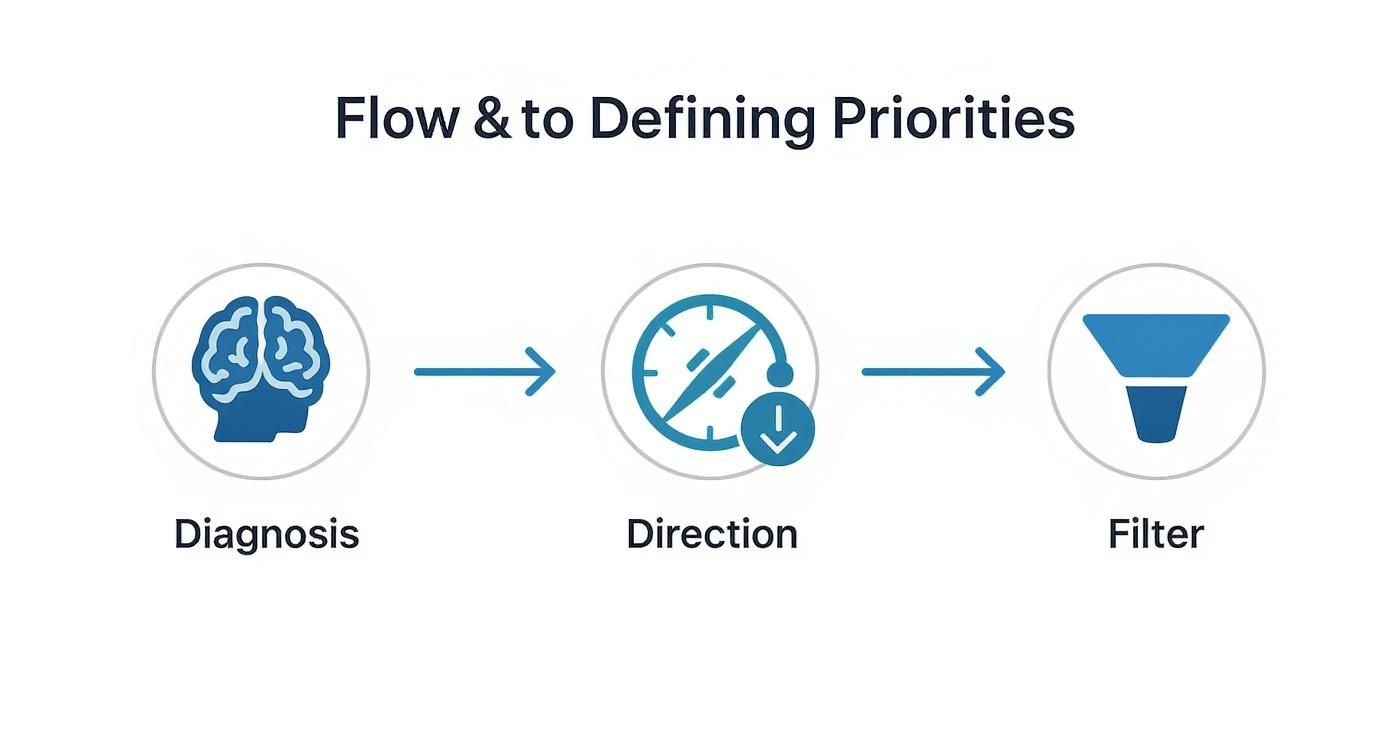
This is the moment we pivot from diagnosis to direction. Without this step, all the organizing in the world is just shuffling deck chairs on the Titanic. It keeps you busy, but you’re still headed for an iceberg.
Real organization isn’t about a color-coded calendar or a perfectly tidy desk. It’s about making sure your daily actions actually line up with what you truly value. Once you have that clarity, it becomes a powerful filter. You’ll find it’s suddenly much easier to say “no” to the things that drain your energy and a confident “yes” to the things that matter.
From Vague Ideas to Concrete Priorities
Most of us can say what’s important—family, health, career. But those are just broad categories. They’re too fuzzy to be useful when you’re deciding what to do at 2 PM on a Tuesday. We need to get specific.
Let’s start by just getting some ideas down. Grab a pen and paper, and brainstorm a bit across these key areas of your life:
- Career & Work: What would a “win” look like in the next year? Maybe it’s getting that promotion, finally learning Python, or just leaving the office on time every day.
- Health & Wellness: Don’t just write “get healthy.” What does that feel like? Does it mean having the energy to play with your kids? Running a 5K? Or finally getting a solid seven hours of sleep every night?
- Relationships: Which connections do you want to intentionally nurture? This could be as simple as a weekly date night, calling your parents more often, or setting aside one weekend a month for friends.
- Personal Growth & Hobbies: What fills your tank? Maybe you want to read 12 books this year, learn a few chords on the guitar, or just have dedicated time for that creative project you keep putting off.
Don’t judge or filter anything yet. Just get it all out.
Select Your High-Impact Goals
Okay, now look at that list. If you’re like most people, you want to do it all. Right now. But we both know that’s a direct flight to burnout. The real secret to progress is focus.
Go through your list and pick just one or two top priorities for each of those life areas. This is tough. It forces you to decide what’s truly non-negotiable for you at this moment. Trying to chase ten “top priorities” is a surefire way to make progress on none of them.
An organized life isn’t about doing more; it’s about doing more of what matters. When you consciously pick a few high-impact goals, you give yourself permission to let the rest go. That’s how you beat overwhelm and actually move forward.
Think about it this way: “get in shape” is a wish. “Complete a 30-minute workout three times a week” is a plan. It’s something you can schedule, track, and actually accomplish. That’s the kind of specific, high-impact goal you’re looking for.
Use Your Priorities as a Decision-Making Filter
Now you have it—a powerful tool for navigating your day-to-day life. Every time a new request, opportunity, or random task lands on your plate, you can run it through a simple filter: “Does this move me closer to my priorities?”
If the answer is no, you have a clear, guilt-free reason to decline, delegate, or simply delete it. This is how you start protecting your time and energy for what counts. If you want a great system for this, our guide on the time management quadrant is the perfect next step. It breaks down how to sort tasks by what’s truly important, not just what’s screaming the loudest.
This filtering process is how you stop reacting to your life and start designing it. Your priorities become the compass that keeps you pointed in the right direction, making every other tactic—from scheduling to habit-building—infinitely more effective.
Build a Framework for Your Ideal Week
Now that you know what matters most, it’s time to build the structure that will actually make it happen. This is where we get practical, moving from high-level goals to a concrete plan for your week. The point isn’t to lock yourself into a rigid schedule but to create a flexible blueprint that brings purpose to all 168 hours you have.
Think of this framework as your first line of defense against decision fatigue—that feeling of being mentally drained from constantly figuring out what to do next. When your week has a shape, you free up precious mental energy for the work itself.
The Power of Time Blocking Your Week
I’m a huge believer in a technique called time blocking. It’s incredibly simple but effective: you give every part of your day a job, just like an appointment in your calendar. Instead of staring at a chaotic to-do list and wondering where to start, you look at your calendar and know exactly what you’re supposed to be doing.
Imagine building a house. You wouldn’t just start laying bricks randomly. You’d follow a blueprint. Time blocking is that blueprint for your time, making sure your biggest priorities get the space they deserve.
Here’s how you can start putting it into practice:
- Deep Work Blocks: Carve out chunks of 90 minutes to two hours for your most challenging, high-focus tasks. Treat this time as sacred.
- Shallow Work Batches: Don’t let little tasks interrupt your flow. Group things like answering emails or returning calls into one or two specific blocks each day.
- Personal Time: This is non-negotiable. Schedule your workouts, hobbies, and family time. If it’s not on the calendar, it’s far too easy for it to get pushed aside.
- White Space: This is crucial. Leave some blocks empty. This buffer is for the unexpected, for creative thoughts to wander, or simply to catch your breath. It keeps your schedule from shattering the moment one thing runs late.
This whole process follows a pretty straightforward workflow: diagnose how you’re currently spending your time, set a clear direction based on your priorities, and then filter all your tasks and appointments through that new lens.
Having this kind of structure isn’t just about getting more done at home; it’s a game-changer for your professional life, too. It’s sobering to realize that only 21% of workers feel engaged at their jobs. A lot of that disengagement comes from feeling a lack of control and purpose. A solid personal organization system gives you back that control. If you’re curious about these kinds of workplace trends, you can find more employee productivity statistics on Archie.
Crafting Your Morning and Evening Routines
Think of your day as being bookended by two golden hours: the first hour after you wake up and the last hour before you go to sleep. Getting intentional about what you do during these times can have a massive ripple effect on your focus and well-being. A morning routine sets you up for a proactive day, while an evening routine helps you wind down for quality rest.
And they don’t have to be complicated. In fact, simple and consistent beats complex and sporadic every single time.
A well-designed routine is like an anchor for your day. It provides stability and structure, ensuring you start and end with purpose, no matter how chaotic the hours in between might get.
A Simple Morning Routine Example
The goal here is to start your day on your own terms, not by reacting to everyone else’s. That means staying away from your phone for the first few minutes. Instead, try a simple flow like this:
- Hydrate: A glass of water before coffee. It’s a small win to start the day.
- Move: Just five minutes of stretching or a quick walk around the block gets the blood flowing.
- Plan: Take two minutes to look at your calendar and remind yourself of your single most important task for the day.
This whole thing takes less than ten minutes, but it completely changes the tone for the rest of your day. You’re in charge.
A Practical Evening Routine Example
Your evening routine is all about signaling to your brain that it’s time to switch off. This is absolutely critical for getting the kind of sleep that recharges you for the next day.
- Digital Sunset: Put your screens away at least 30-60 minutes before you plan to sleep. The blue light is a well-known sleep disruptor.
- Quick Tidy: A five-minute cleanup of your desk or kitchen makes a world of difference. Waking up to a clean space is a gift to your future self.
- Mindful Disconnect: Ditch the screen for a physical book, a journal, or some calming music. Let your mind decompress.
By building these small, repeatable routines, you create a reliable foundation for your days. This structure cuts down on the mental energy you waste on planning, freeing you up to focus on the deep, meaningful work that truly moves the needle.
Choose the Right Tools to Support Your System
A great system is the engine that drives an organized life, but the right tools are the fuel that keeps it running. The goal isn’t to collect a dozen flashy apps that all promise to be the next big thing. It’s about hand-picking a few key tools that feel like a natural extension of how you already think and work.
Think of it this way: the wrong tools add another layer of complexity, another thing to manage. The right ones, however, remove friction and make it easier to stick with the habits you’re trying to build.
Your tools should always serve your system, never the other way around. If you find yourself spending more time fiddling with your productivity app than actually being productive, it’s a big red flag. Simplicity is the name of the game.
Building Your Minimalist Tech Stack
When you first start trying to organize your life, it’s tempting to download every top-rated app you see. Resist that urge. Instead, focus on building a minimal, integrated “tech stack” that handles the three core jobs of any good organizational system.
You need to be able to capture ideas, manage tasks, and schedule your time. That’s it.
- A Calendar: This is for anything with a hard date and time. Think meetings, appointments, and those time blocks you’ve so carefully planned. A digital calendar like Google Calendar or Apple Calendar is a solid choice because you can share events and get reminders.
- A Task Manager: This is your to-do list headquarters. It’s where you keep track of all the things that need to get done but don’t necessarily have a fixed time slot. Tools like Todoist, Things 3, or even a simple notes app can work wonders here.
- A Note-Taking App: This is your external brain. It’s a single place to dump thoughts, meeting notes, project ideas, and anything else you want to remember later. Evernote or Apple Notes are great for keeping everything organized and searchable.
The best tool is always the one you actually use. An old-school paper planner you open every day is infinitely more powerful than a fancy app you open once a month.
Figuring out what works for you is a personal journey. For example, if you’re a Mac user, it’s worth exploring the best productivity apps for Mac to find options that play nicely with your existing setup. The main thing is to find tools that feel intuitive and align with your natural workflow.
The Critical Role of a Clutter-Free Environment
Your surroundings—both physical and digital—have a massive impact on your ability to focus. A messy desk or a desktop wallpaper buried under random files creates a low-level hum of distraction, constantly pulling at your attention. Decluttering isn’t just about making things look nice; it’s a practical step toward doing better work.
Start with your physical workspace. Get rid of anything that doesn’t have a direct purpose for the task at hand. Give every item a home, so you’re not wasting mental energy just looking for a pen. It’s a small change that can create a huge sense of calm and control.
Your digital space needs the same treatment. This means turning off notifications that aren’t urgent, organizing your computer files into a logical folder structure, and finally getting that email inbox to zero. When you’re picking your tools, remember that how you organize your digital information for peak efficiency is just as important as managing physical clutter.
This idea goes beyond just files. How you organize your data has become a fundamental life skill. Businesses have shown that better information systems directly lead to increased productivity, and there’s no reason you can’t apply that same principle to your own life. When you systematically manage your records and tasks, you build a solid foundation for getting things done.
Make Your System Last with a Weekly Review
So, you’ve done the hard work. You audited your time, figured out what truly matters, and built a solid framework for your days. But here’s the thing about getting organized: it’s not a one-and-done project. It’s a living, breathing process.
The single most important practice that makes it all stick is the Weekly Review. This is what separates a system that works for a month from one that supports you for years.
Think of it as a simple, powerful 30-minute ritual to check in with yourself. It’s your chance to look back at what worked, see what went off the rails, and plan the week ahead with real intention. Without this, even the most perfect plan will slowly start to unravel as life inevitably gets in the way. It’s the glue that holds everything together.
What Exactly Is a Weekly Review?
It’s basically a short, honest meeting with yourself. You hit pause on all the “doing” and shift into thoughtful “planning” mode. It’s a scheduled moment to make sure your daily actions are still pointing toward your long-term goals.
By carving out this time, you guarantee that you walk into every Monday with clarity and control, instead of that familiar feeling of scrambling to figure out what to tackle first. It’s how you turn a temporary fix into a permanent way of operating.
Your Simple Weekly Review Checklist
You don’t need anything fancy. Just find 30 minutes on a Friday afternoon or Sunday evening when you can think clearly. Grab your calendar and your task list, and run through these steps. The key is consistency, not perfection.
-
Clear the Decks: First, round up all the loose ends from the past week. Process your physical mail, get your email inbox to zero, and empty out that “quick notes” list on your phone. The goal is to get everything out of your head and into your system for a clean slate.
-
Review Your Calendar: Look back at the past seven days. What went well? Where did you feel overscheduled or rushed? Did you actually make time for what you said was important? Then, glance ahead. Do you need to prep for any big appointments? Are your non-negotiable time blocks for deep work or family time still protected?
-
Check on Your Goals: Now, zoom out and look at your bigger goals. Did you make any progress this week? Even a tiny step counts. What’s just one thing you can schedule for the upcoming week to keep the momentum going? This simple step keeps your big dreams from getting lost in the daily grind.
Your organizational system should be a support, not a straitjacket. The weekly review is your opportunity to loosen the bolts, make adjustments, and ensure the entire framework still fits the life you’re actually living.
Handling Setbacks and Staying on Track
Let’s be real—life happens. A crazy week at work, a sick kid, or an unexpected personal issue can throw anyone for a loop. When you get knocked off course, it’s not a failure of your system. A good system is built for this; it’s designed to help you recover.
Don’t try to fix everything at once. Just commit to doing your next Weekly Review, no matter how messy the last week was. That one action is often all it takes to reset your focus and feel back in control. It lets you acknowledge the chaos, adjust your plan, and move on without the guilt.
If a priority has legitimately changed—maybe a new project just became urgent, or a family situation needs more of your time—the review is the perfect place to make that adjustment consciously. An organized life isn’t about sticking rigidly to a plan that no longer works. It’s about having the clarity to adapt with purpose. This review is what keeps you in the driver’s seat for good.
Got Questions? Let’s Talk Through the Sticking Points
Starting this process of getting organized is a huge step, but it’s totally normal to have questions or hit a few speed bumps. Honestly, everyone does. Let’s cover a few of the most common concerns I hear from people when they’re trying to build a new system that actually sticks.
So, How Long Does This Actually Take?
This is usually the first question people ask, and the real answer is that getting organized isn’t a one-and-done project. It’s more like building a muscle. You’ll start feeling a real difference in your sense of control and clarity within just two to four weeks if you stick with it.
The upfront work—like the time audit and figuring out your real priorities—might take a solid afternoon or a few hours over a weekend. After that, the magic is in the day-to-day consistency.
Remember, the goal here is to build a system that lasts and can adapt with you, not to hit some state of short-lived perfection. Focus on making small, steady changes. That’s what creates real, lasting impact.
What Happens When My Perfect System Falls Apart?
First off, it will fall apart at some point. A crazy week at work, a family emergency, or just plain burnout will throw a wrench in your plans. This isn’t a sign that you’ve failed; it’s a sign that you’re human. A good system is built to be resilient, not rigid.
When you feel things derailing, the worst thing you can do is try to fix everything all at once. That’s a direct path to feeling completely overwhelmed. Instead, just get back to one simple, foundational habit.
- Just plan tomorrow. Before bed, spend five minutes deciding on your top one to three tasks for the next day. That’s it.
- Do a quick reset. A 15-minute weekly review is often all it takes to see where you are and get back in the driver’s seat.
- Remember your “why.” Take a quick look back at those core priorities you set. It’s a surprisingly powerful way to remind yourself why this matters.
Action is what brings back motivation, not the other way around. One small, intentional step is all you need to get back on your feet.
Do I Really Need a Bunch of Apps and Digital Tools?
Nope, definitely not. Digital calendars and fancy task managers can be amazing, but they aren’t for everyone. I know plenty of incredibly organized people who run their lives with a simple notebook.
The principles are what matter: understanding where your time goes, setting clear priorities, and reviewing your progress. The tool is just how you get it done.
You could try:
- A classic paper planner for a great visual of your week.
- The bullet journal method if you crave flexibility.
- A basic notebook and a few sticky notes for managing daily to-dos.
If you find yourself spending more time fiddling with an app than actually doing the work, it might be a sign to switch. The best tool is always the one you’ll actually use consistently. Don’t get hung up on finding the “perfect” app; focus on building the habit first.
Ready to gain crystal-clear insights into your productivity without the hassle of manual timers? Chronoid automatically tracks your app and website usage, revealing exactly where your time goes. Use its AI-powered chat and built-in focus tools to block distractions and optimize your workflow. Start your free 7-day trial today and see the difference for yourself. Learn more about Chronoid.