
You shut the laptop after a long day and still feel behind. You answered messages, moved deadlines, fixed a client request, sat through calls, and bounced between tabs so often that your attention never fully landed anywhere. The day was full. It just wasn’t satisfying.
That’s the part most productivity advice misses. The problem usually isn’t a lack of effort. It’s that too much of your time gets spent in fragments. Freelancers, creatives, consultants, and remote workers know this feeling well because nobody is standing over your shoulder telling you what matters most. You have to decide that for yourself while notifications, admin work, and other people’s urgency keep trying to decide for you.
The Busy Trap and the Quest for Time Well Spent
A lot of people are living in a version of the same day. You start with one important task in mind. Then Slack pings. Email fills up. A client wants “just a quick change.” You open your calendar to check one thing and forget why you were there. By late afternoon, you’ve touched twenty things and finished almost none of the work that moves your life forward.
That’s the busy trap. Activity replaces progress. Motion replaces meaning.
For independent professionals, this gets expensive fast. When your energy is your business model, scattered attention doesn’t just make you tired. It weakens creative quality, extends simple tasks, and blurs the line between work time and recovery time. If you’re neurodivergent or easily pulled by novelty, the cost is even sharper because every interruption leaves residue.
The larger culture is moving in the same direction. For people aged 15 to 24, time with friends fell from about 150 minutes per day in 2003 to less than 50 minutes per day in 2020, a drop of roughly 1.8 hours daily. By 2020, this group was spending more than twice as much time with devices as with people, according to this analysis of time-use trends. That shift matters because it shows how easily device time expands while richer forms of attention and connection shrink.
Why busyness feels productive when it isn’t
Busy work gives quick emotional rewards. You reply, check, clear, send, update. Each action feels responsible. But many of those actions are maintenance, not momentum.
Practical rule: If a day contains constant response but little reflection, it will feel full and still feel empty.
That’s why “time well spent” matters. It asks a better question than “How much did I do?” It asks, “Did the way I spent my hours match what I say matters?”
Real trade-offs you can’t ignore
A stronger schedule doesn’t come from squeezing harder. It comes from choosing what gets protected.
- Deep work needs protection: Creative and analytical work usually loses against open-ended communication unless you block space for it.
- Recovery has to count: Rest isn’t leftover time. It’s part of the system that makes focused work possible.
- Relationships need intention: If connection is always delayed until you “have time,” it keeps getting cut.
If your days have started to feel like one long reaction loop, it helps to revisit practical strategies for improving work-life balance that protect both work output and personal bandwidth.
Defining Time Well Spent Beyond Simple Productivity
Think of your time the way you’d think about food. Some things fill you up but don’t nourish you. Other things may take effort, yet leave you stronger, clearer, or more grounded afterward.
That’s the difference between raw productivity and time well spent.
A packed schedule can still be low-value. You can answer messages for hours and never touch meaningful work. You can also spend an afternoon resting, walking, or talking with someone you care about and come away with more clarity than you got from half a day at your desk. The point isn’t constant output. The point is whether an activity deserved the time it took.
The four ingredients that matter
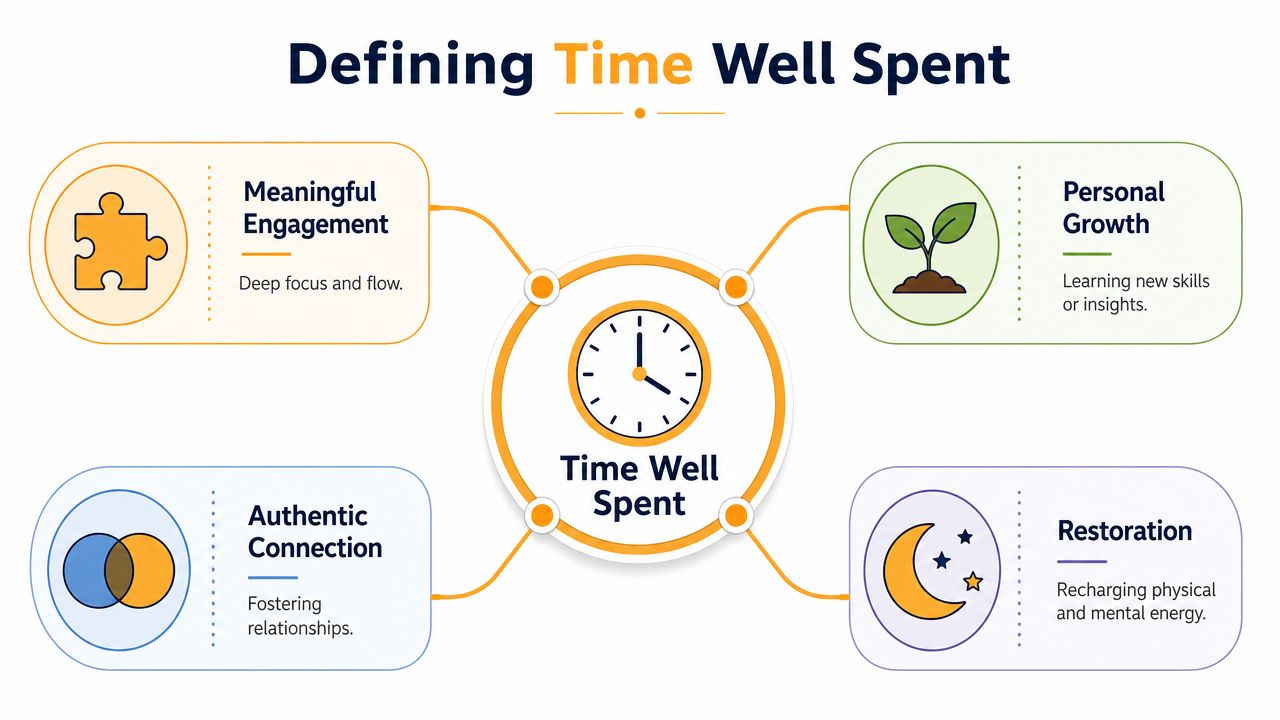
Most useful schedules include four kinds of value.
| Pillar | What it looks like in real life |
|---|---|
| Meaningful engagement | Writing, designing, coding, planning, or solving a hard problem with full attention |
| Personal growth | Learning a tool, building judgment, reviewing mistakes, practicing a skill |
| Authentic connection | Talking with a partner, meeting a friend, helping a client in a thoughtful way |
| Restoration | Sleep, breaks, exercise, walking, quiet, play, and unstructured recovery |
When people struggle with time, they often overfeed one pillar and starve the others. A freelancer may overinvest in client response and neglect restoration. A creative may chase inspiration and avoid admin until it becomes a mess. A consultant may stay productive on paper while living in constant depletion.
Subjective value changes the whole conversation
The most useful idea here is subjective value of time. MIT Sloan Review describes it as a measurable, activity-level metric that varies across weekly activities and can be mapped to identify which activities are most worth increasing or reducing in your life, as explained in its piece on valuing time differently.
That matters because the same activity can have very different value depending on context.
- Email at 9:30 a.m. before you start your core work may be avoidance.
- Email at 4:30 p.m. to close loops may be useful.
- A walk in the middle of the day may be procrastination once. It may be recovery the next day.
- A client call may be draining if it’s reactive, but energizing if it clarifies the project.
Time quality isn’t only about what you did. It’s about why you did it, how present you were, and what it made possible afterward.
If you miss this point, you end up using blunt metrics. Less screen time. More hours worked. More tasks done. Those measures can help, but they don’t tell you whether the day was aligned, focused, or human.
Frameworks to Evaluate the Quality of Your Time
Individuals often struggle to recall how they spent a day. They remember the stress. They remember the hardest moment. They remember the one thing they didn’t finish. That’s why evaluation needs structure.
On an average day, people spent 35 minutes socializing and communicating and 34 minutes playing games and using a computer for leisure, according to the American Time Use Survey summary discussed in Our World in Data’s overview of time use. The important takeaway isn’t moral panic about screens. It’s that discretionary time is limited, and small choices compete closely with each other.
A simple filter for any task
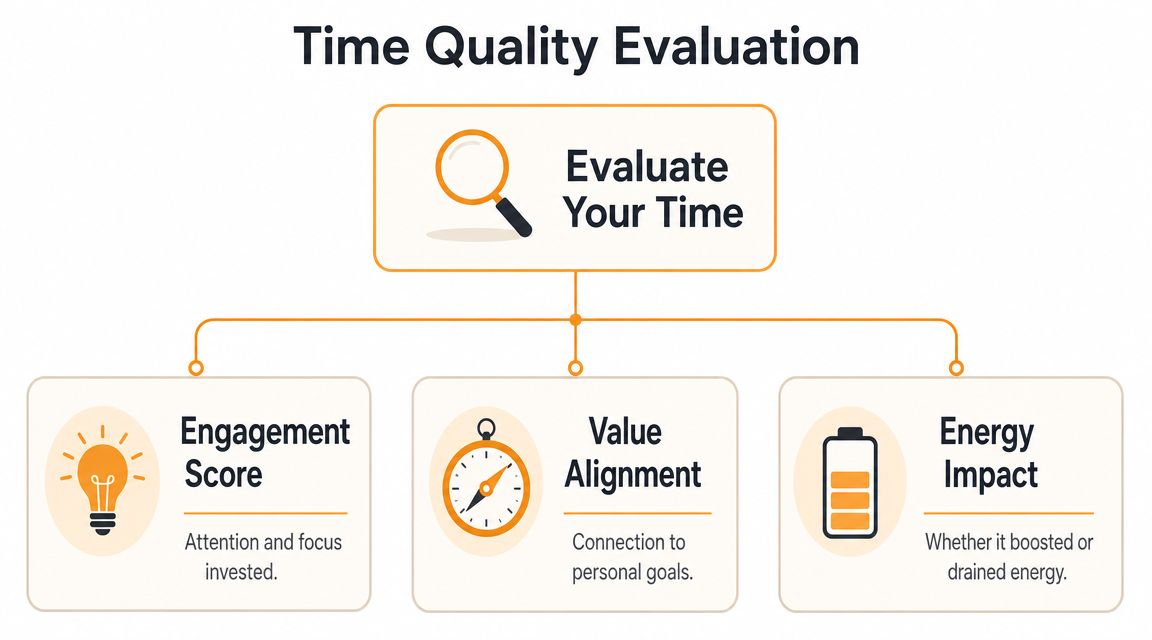
Use three lenses instead of one.
-
Engagement score
Ask how present you were. Did you work with full attention, or did you keep switching windows and checking messages? A task done in fragments often costs more than the clock suggests. -
Value alignment
Ask whether the activity supported a meaningful goal, responsibility, or relationship. Not every task will feel exciting, but it should connect to something that matters. -
Energy impact
Ask what the activity did to your mental state. Some work is tiring in a good way. Some work leaves you foggy, resentful, or overstimulated.
A task can be urgent and still score poorly on quality. It can also look small on paper and still be high-value because it prevents chaos later.
The value versus urgency check
The classic quadrant still helps, but only if you add quality. If you need a refresher, this guide to the time management quadrant is a useful reference point.
Try this adaptation:
- High urgency, high value: client deliverables, deadlines, hard commitments
- Low urgency, high value: strategy, planning, portfolio building, relationship care
- High urgency, low value: many interruptions, status requests, avoidable fire drills
- Low urgency, low value: drift, doomscrolling, excessive tinkering, fake prep
The second category is where a good life gets built. It’s also the category often sacrificed first.
A weekly time quality audit
At the end of the week, don’t start with the calendar. Start with memory.
Ask yourself:
- What gave me energy?
- What drained me faster than it should have?
- What felt meaningful enough that I’d want more of it next week?
Then compare those answers to how your hours were used.
If your calendar says one thing and your body says another, believe both. The schedule shows allocation. Your energy shows quality.
Patterns become visible. You may notice that meetings aren’t the problem. Back-to-back meetings are. Admin may be fine when batched and miserable when scattered all day. Creative work may go well in the morning and badly after lunch. Those are the details that help you redesign your week.
Actionable Strategies for More Time Well Spent
Better time quality doesn’t come from a prettier planner. It comes from reducing friction around what matters and increasing friction around what derails you.
Protect fewer things, but protect them hard
Trying to improve everything at once often fails because the schedule becomes another source of pressure. Pick two or three categories to defend.
For many freelancers and creatives, those are:
- Deep work blocks for making, writing, editing, designing, or coding
- Admin batches for invoices, email, scheduling, and file cleanup
- Recovery windows that are real breaks, not phone breaks disguised as rest
A protected block should have a job. “Work on project” is too vague. “Draft homepage copy” is specific enough to start.
Build friction against distraction
Distraction wins when access is easy. Don’t rely on discipline alone.
Try a setup like this:
- Batch communication: Check email and messages at set times instead of grazing all day.
- Use blockers during focus windows: Remove the sites and apps you always reach for when work gets uncomfortable.
- Keep capture tools nearby: If random ideas pull you off task, write them down fast and return to the work.
- Create a shutdown ritual: End with tomorrow’s top task, a clean desktop, and a clear stopping point.
For readers who deal with attention regulation, especially adults with ADHD, Sachs Center’s time management advice offers practical ideas that fit real cognitive constraints rather than idealized routines.
Don’t optimize your day into a cage
There’s a contrarian view worth keeping. Constant optimization can become its own stressor. A healthier approach emphasizes protecting recovery and deep focus rather than maximizing output at all times, as discussed in this talk on rethinking optimization pressure.
That warning matters because “time well spent” can get twisted into “every minute must justify itself.” That’s not the goal.
A good system makes room for:
- boredom
- walks
- conversation
- slow starts after hard weeks
- work that matters but doesn’t produce an immediate visible result
A walk without a podcast can be more valuable than an hour of forced productivity when your brain is overloaded.
The right question isn’t whether every block looked efficient. It’s whether your week contained enough focus, enough recovery, and enough meaning to be sustainable.
Measure What Matters with Automatic Time Tracking
People almost always misjudge where their time goes. Not because they’re careless, but because memory smooths things out. It turns a day of interruptions into “I worked all day.” It turns fragmented effort into imagined focus.
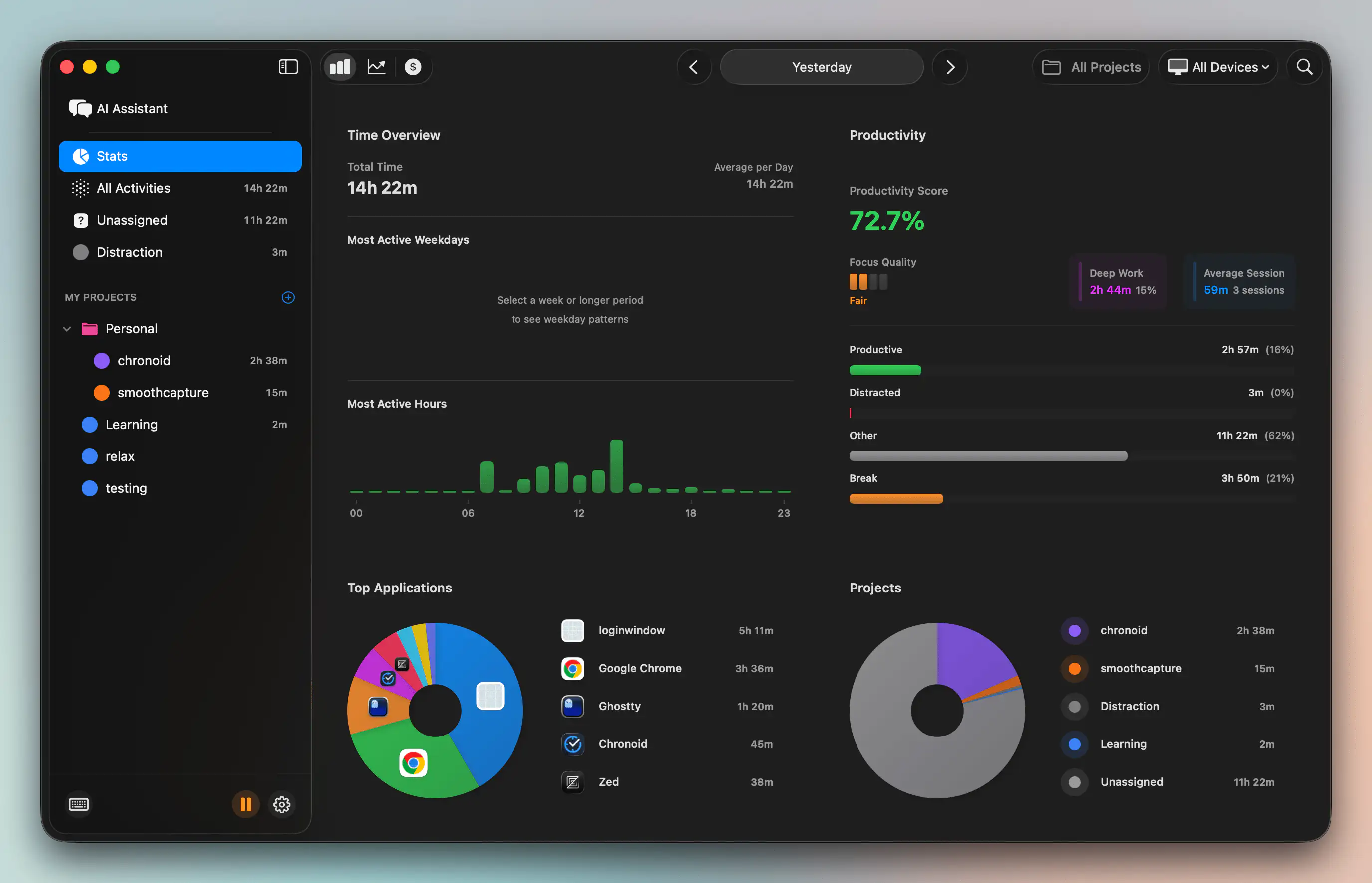
Research also points to a tension between self-reported productivity and actual time quality. People need better ways to interpret whether tracked time was deep work, fragmented work, or invisible labor, based on this research summary on time quality and work interpretation.
Why manual logs usually fall apart
Manual tracking sounds simple until real work starts. You forget to start a timer. You leave one running too long. You round generously. You skip the messy bits like context switching, rabbit holes, and half-finished admin.
That’s why automatic tracking is useful. It gives you a factual baseline. Then you can layer judgment on top of it.
One tool in this category is Chronoid, a macOS app that automatically tracks apps, websites, and documents, detects idle time, and uses AI-powered categorization with an on-device chat interface so you can ask questions about how your time was spent. If you’re comparing approaches, it helps to understand how a modern time tracker clock differs from old start-stop timer habits.
What to look for in your data
Raw hours aren’t enough. Ask better questions of the record.
| Question | Why it matters |
|---|---|
| When did I do my best focused work? | Helps you place demanding tasks at the right time of day |
| What broke my concentration most often? | Identifies recurring interruption sources |
| How much time went to client value versus admin overhead? | Shows where your business may be leaking attention |
| Which projects felt heavy because they were fragmented? | Separates hard work from broken work |
Once you can see the pattern, you stop arguing with vague feelings. You can tell whether you really lacked time, or whether the day got shredded.
A short demo helps make that concrete.
Use tracking to judge quality, not just quantity
The most useful review is not “How many hours did I work?” It’s questions like:
- Which hours were focused enough to count as real progress?
- Which blocks looked productive but were mostly switching and cleanup?
- Which recurring tasks belong in a batch, template, or system?
That’s how measurement becomes practical. The data doesn’t tell you what matters. It helps you see whether your schedule matched what matters.
Building a Daily Routine for Intentional Work
A good routine doesn’t need to be strict. It needs to make the right actions easier than the wrong ones.
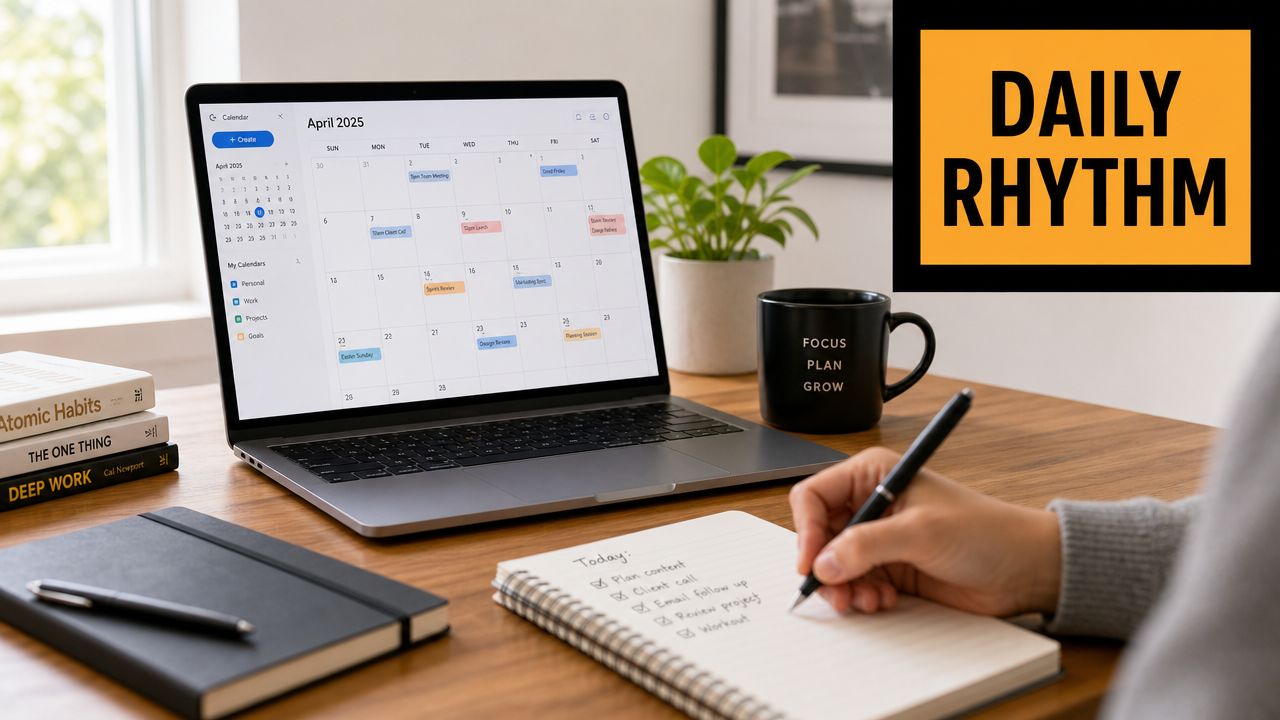
A simple rhythm that works
Start the morning by naming one meaningful outcome. Not five. One. Then give it the first clean block of attention you have. If you need structure, this guide on how to time block can help you assign real jobs to each part of the day.
Midday, pause before autopilot takes over. Ask three quick questions: Am I still doing the work that matters today? What is draining me? What needs to move to later, delegate, or drop? This prevents a whole afternoon from disappearing into reaction mode.
In the second half of the day, switch to lighter work on purpose. That’s the time for admin, communication, scheduling, revisions, and cleanup. Don’t waste your best cognitive window on tasks that can survive lower energy.
End the day before it spills into the night
A firm shutdown is part of time well spent. Write tomorrow’s first task. Close loose tabs. Capture anything unfinished. Then stop.
The day feels lighter when tomorrow has already been opened for you.
That rhythm is simple, but it works because it respects quality. It gives your best attention to meaningful work, contains distractions instead of fighting them every minute, and protects recovery so you can repeat the pattern without burning out.
If you want a clearer picture of where your hours go, Chronoid gives Mac users an automatic record of apps, websites, and documents, plus focus tools and AI-assisted analysis to help separate deep work from fragmented work. It’s a practical way to measure time well spent without relying on memory or manual timers.